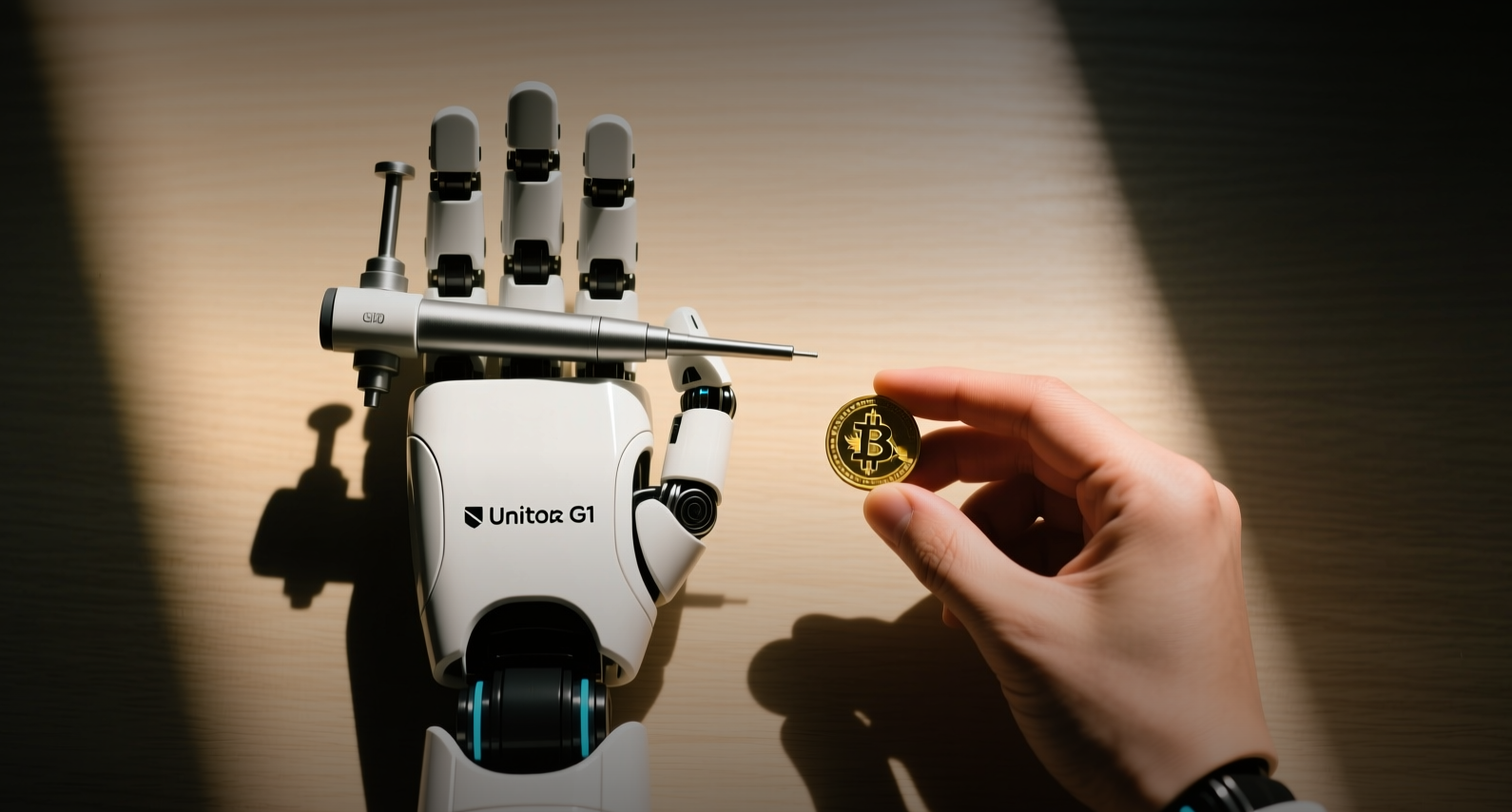
A $13,500 humanoid robot performed gallbladder surgery on live pigs in a world-first preclinical trial, challenging the dominance of million-dollar surgical systems.
Researchers at the University of California San Diego modified a Unitree G1 humanoid robot — a 5-foot-tall, 60-pound machine that normally costs $13,500 in its base configuration — to hold laparoscopic instruments and perform two cholecystectomies on live pigs via remote teleoperation. The results were published Wednesday in Nature.
"The cost is a fraction and it takes a fraction of the space in an operating room, so it's easy to deploy anywhere from rural areas to the battlefield and even to space," said Shanglei Liu, an assistant professor of surgery at UC San Diego School of Medicine and co-author of the study.
The G1 robot, made by Chinese robotics company Unitree, costs $13,500 for the baseline model with non-functional hands and up to $67,000 with dexterous hand upgrades. That compares with Intuitive Surgical's da Vinci system, which ranges from $500,000 to several million dollars and weighs about 1,800 pounds. The G1's 450-millimeter arm span — less than a third of an adult human's reach — constrained surgical access and required frequent recalibration, the team said.
The trial's implications extend beyond cost. Traditional surgical robots like da Vinci require dedicated operating rooms, specialized instruments and trained support teams, limiting their deployment to well-funded hospitals in urban centers. A humanoid robot that can use existing surgical tools and work in standard operating rooms could expand access to minimally invasive surgery in rural clinics, military field hospitals and potentially space stations, the researchers said.
The Surgeon Behind the Console
A surgeon seated at a control console wore a stereo headset displaying the endoscopic view and used two master hand controllers to manipulate the robot's wrists in real time. A foot pedal engaged or disengaged the motion mapping. The first surgery paired one robot with a human bedside assistant; the second used two robots working together.
The approach mirrors how early laparoscopic robotic surgery evolved. The first da Vinci cholecystectomy took six hours; today the same procedure takes about 30 minutes. In this trial, console time dropped from 56 minutes and 15 seconds in the first case to 31 minutes and 59 seconds in the second — a 43% improvement across just two procedures.
Still, the system required multiple pauses for recalibration and physical repositioning of the robot body, extending total procedure time beyond what specialized surgical systems require. Latency between the surgeon's hand movements and the robot's response measured in the hundreds of milliseconds, above the 150-millisecond threshold that prior studies identify as ideal for telerobotic surgery.
What This Means for the Surgical Robotics Market
Intuitive Surgical's da Vinci franchise generated $7.1 billion in revenue in 2025, according to the company's annual filing, supported by an installed base of more than 9,000 systems worldwide. The high cost and infrastructure requirements have created a market gap for lower-cost alternatives, particularly in emerging economies where surgical robot penetration remains below 5% of hospitals.
The UC San Diego team is exploring autonomous capabilities for future versions. "One of our goals is to develop an autonomous surgical assistant that can work alongside human surgeons," said Michael Yip, a professor of electrical and computing engineering at UC San Diego and the lab's director. That vision includes robots that fetch tools, adjust lighting and clean operating rooms between procedures.
For investors, the trial validates the thesis that general-purpose humanoid robots — a category that includes Tesla's Optimus, Figure AI's Figure 02 and Boston Dynamics' Atlas — can address specialized medical tasks without custom hardware. Unitree, which does not trade publicly, competes in a humanoid robotics market that Goldman Sachs estimates could reach $38 billion annually by 2035. Intuitive Surgical shares, trading at 58 times forward earnings, face a long-term structural question: whether specialized surgical robots can maintain their pricing power as general-purpose humanoids improve.
This article is for informational purposes only and does not constitute investment advice.