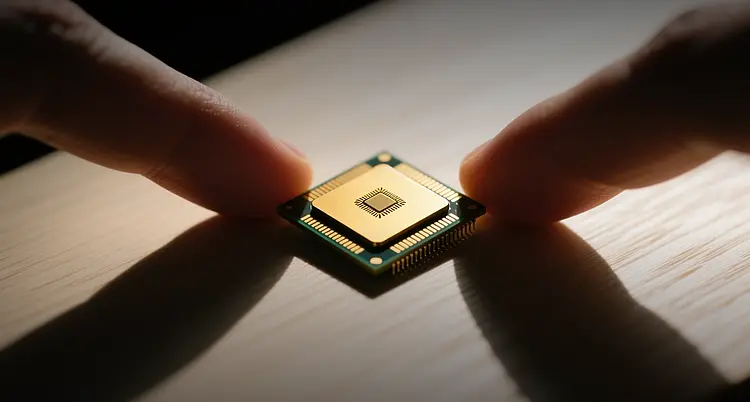
Samsung's 2nm tape-out of Tesla's AI5 chip marks the first large-scale commercial order for the Korean foundry's most advanced node and a potential turning point for its loss-making foundry division.
Samsung Electronics has completed the tape-out of Tesla's next-generation AI5 chip on its 2-nanometer process, handing the Korean foundry its first marquee commercial order for the bleeding-edge node at its Taylor, Texas plant.
"The Tesla-Samsung AI5 chip has reached tape-out and is scheduled to be manufactured at the Taylor fab using our latest 2nm process," James Kim, a principal engineer at Samsung Foundry, wrote on LinkedIn before deleting the post, according to industry officials.
The AI5 chip delivers roughly 2,000 to 2,500 trillion operations per second, about eight times the compute of Tesla's current AI4 hardware, with transistors 3.5 times smaller than the prior generation, per data from Elon Musk's public statements and industry reporting. The chip supports up to 192 gigabytes of LPDDR5X memory from SK Hynix and draws 700 to 800 watts at peak — more than double the AI4's 300-watt power envelope. Samsung's 2nm yield has reportedly exceeded 60 percent, a threshold that makes the node commercially viable for high-volume production.
The AI5 order, part of a roughly 22.7 trillion won ($17 billion) foundry contract Samsung signed with Tesla last year, could help reverse the foundry division's estimated 600 billion won ($460 million) quarterly operating loss. Samsung's non-memory business posted a loss in the second quarter while the memory division contributed more than 90 percent of the company's 8.94 trillion won operating profit.
Taylor Fab Gets Its Anchor Customer
The Taylor plant, expected to begin initial operations by the end of this year, will start full-scale production of AI5 chips from 2027. The facility represents Samsung's most ambitious bet to challenge Taiwan Semiconductor Manufacturing Co.'s dominance in advanced foundry services. TSMC will also produce a version of the AI5 chip at its Arizona facility, giving Tesla dual sourcing for its most strategically important silicon.
Tesla's AI chip roadmap spans multiple generations — AI4 (currently shipping in vehicles), AI4 improved, AI5, AI6, and AI6.5 — with Samsung handling AI4 production at its Pyeongtaek facility in Korea, splitting AI5 with TSMC, taking sole responsibility for AI6, and ceding AI6.5 to TSMC. The chips are designed for full-self-driving systems, the Optimus humanoid robot, and Tesla's Dojo supercomputer clusters.
What Tape-Out Means for Production
Tape-out is the semiconductor industry's final design milestone, where a chip's layout is frozen and handed to the fab for manufacturing. Engineering samples typically follow within months, with high-volume production targeted for late 2026 or early 2027, according to TrendForce. Musk has said AI5 is currently "overengineered for cars" and that the near-term priority for the chip is Optimus and data center clusters rather than vehicles, with high-volume automotive deployment expected in mid-to-late 2027.
Competitive Implications
The Samsung win chips away at TSMC's near-monopoly on advanced AI silicon. TSMC currently manufactures Nvidia's Blackwell and Hopper GPUs, AMD's MI300 series, and most of Apple's A-series and M-series processors on its 3nm and 5nm nodes. Samsung's 2nm yield improvement — crossing the 60 percent threshold that makes the node commercially viable — signals that the foundry may be closing the manufacturing gap with its Taiwanese rival. The company is also reportedly in discussions with Anthropic to manufacture its custom AI chips, suggesting the 2nm node is attracting a pipeline of customers beyond Tesla.
Samsung Electronics shares trade at a discount to TSMC on a price-to-earnings basis, reflecting the market's skepticism about its foundry turnaround. The AI5 order provides a tangible revenue catalyst: if Samsung can deliver 2nm wafers at scale for Tesla, it unlocks a foundry customer base that has been almost exclusively served by TSMC. For Tesla, the dual-sourcing arrangement with Samsung and TSMC reduces single-point-of-failure risk in its AI chip supply chain — a critical consideration as the company scales production of Optimus robots and autonomous vehicles.
This article is for informational purposes only and does not constitute investment advice.