

Nvidia's slide to $195 marks the steepest drawdown among chip stocks this year as hyperscaler in-house chip development threatens to erode the company's AI monopoly.
Nvidia's slide to $195 marks the steepest drawdown among chip stocks this year as hyperscaler in-house chip development threatens to erode the company's AI monopoly.
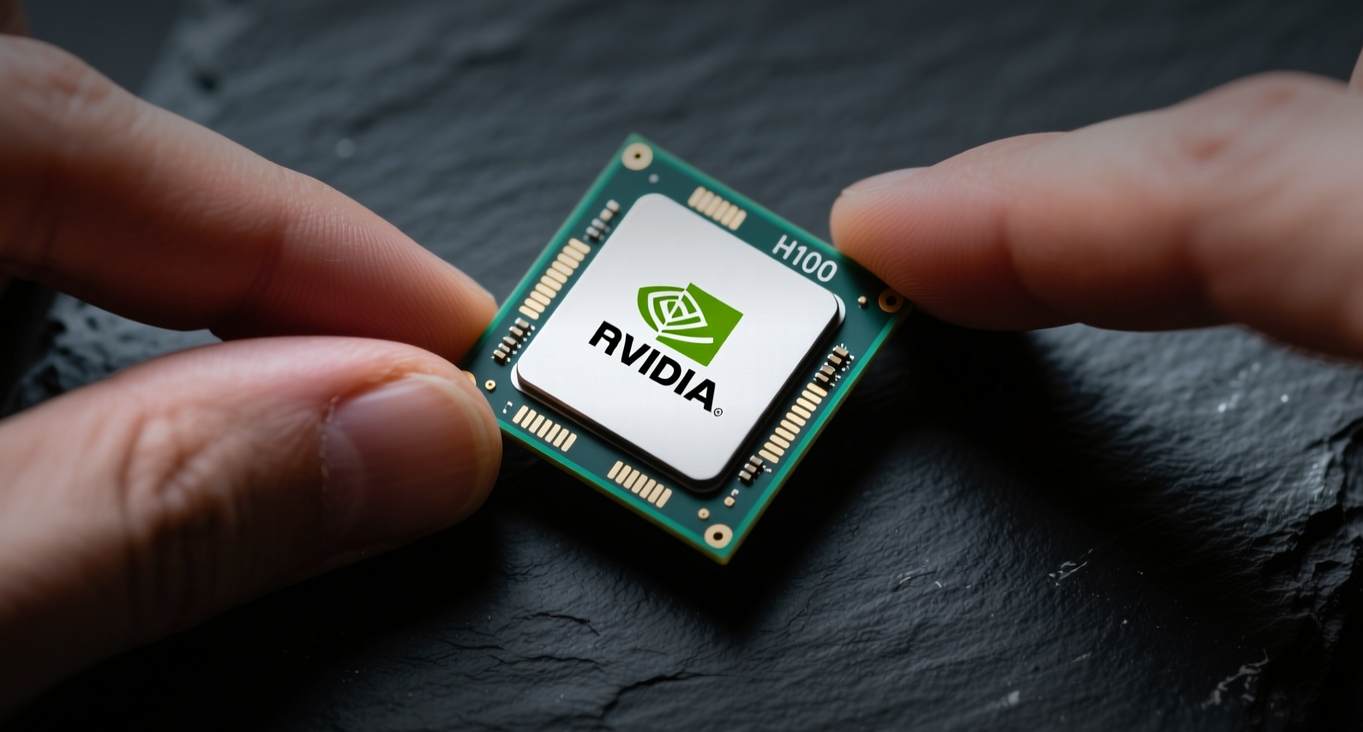
Nvidia's slide to $195 marks the steepest drawdown among chip stocks this year as hyperscaler in-house chip development threatens to erode the company's AI monopoly.
Nvidia shares slid to their lowest since April after a report that another major customer is developing in-house AI chips, threatening the company's dominance in a data center chip market that generated $62 billion in revenue last fiscal year.
"Vertical integration by hyperscalers poses the most significant structural risk to Nvidia's pricing power," said Stacy Rasgon, senior analyst at Bernstein. "Each defection to in-house silicon erodes a piece of the moat."
The stock traded near $195, down 18% from its June high and 10.7% in June alone. Nvidia has become the worst performer in its own chip group this year, trailing a semiconductor ETF up nearly 59%, while Advanced Micro Devices and Micron Technology have each gained well over 100%. The latest pressure follows a report that another unnamed customer is developing its own AI accelerator, joining a list that includes Microsoft, Amazon, and Alphabet.
The shift threatens Nvidia's pricing power in a market where its H100 and Blackwell chips command premium margins. Microsoft, which trades at 19.3 times forward earnings after hitting a 52-week low near $353, has already deployed its Maia AI accelerator internally. If a third hyperscaler follows suit, it could redirect billions in annual GPU procurement spend away from Nvidia.
The in-house chip trend has accelerated as AI workloads shift from training to inference, a task where general-purpose graphics processing units face competition from purpose-built silicon. Amazon's Trainium chips, built on TSMC's 3-nanometer process (the most advanced node for high-performance computing), already power parts of its AWS cloud. Alphabet's Tensor Processing Units have been deployed internally for years.
Nvidia's response has been to accelerate its own product cadence. The Blackwell architecture, which succeeded Hopper, doubled memory bandwidth and improved energy efficiency — but hyperscaler investment in alternatives has not slowed. Combined capital expenditure from Microsoft, Amazon, Meta Platforms, and Alphabet is expected to exceed $250 billion this year, with a growing share directed at custom silicon.
The competitive pressure comes as broader AI sentiment cools. OpenAI, whose ChatGPT launch sparked the AI investment wave, may delay its initial public offering to 2027 to protect a $1 trillion valuation, Reuters reported in late June. When the industry's marquee name hesitates to test public markets, investors grow cautious on stretched valuations across the AI supply chain.
Trading data paints a mixed picture. Chaikin Money Flow, which tracks whether institutional investors are buying or selling, has climbed since June 25 and now sits near zero at negative 0.01 — hinting that money is trickling back in early July but not yet confirming a reversal. Options activity shows a slightly bullish tilt, with the put-call ratio by volume at 0.48, while large traders maintain a net short position of about $16.7 million in Nvidia, the heaviest short among major chip names.
Still, the downside risk appears contained. Leveraged exchange-traded fund bets on Nvidia total about $5.6 billion against $28.8 billion in daily trading volume, a far less crowded position than the leverage seen in Korean chip stocks like SK Hynix, according to The Kobeissi Letter.
Washington has provided a partial offset, issuing licenses for Nvidia to sell its H20 chips in China again, reopening a key market that US export controls had blocked. And the upcoming earnings reports from Microsoft, Meta, Amazon, and Alphabet in late July could boost the stock if they announce strong AI spending plans — which would translate directly into more Nvidia chip orders.
Nvidia's own fiscal first-quarter results landed in May, and the stock posted its best monthly returns in April and May of that quarter. If the pattern holds, July could see a recovery. But with the next Nvidia earnings report not due until late August, the month hinges on external events rather than company-specific numbers.
This article is for informational purposes only and does not constitute investment advice.
