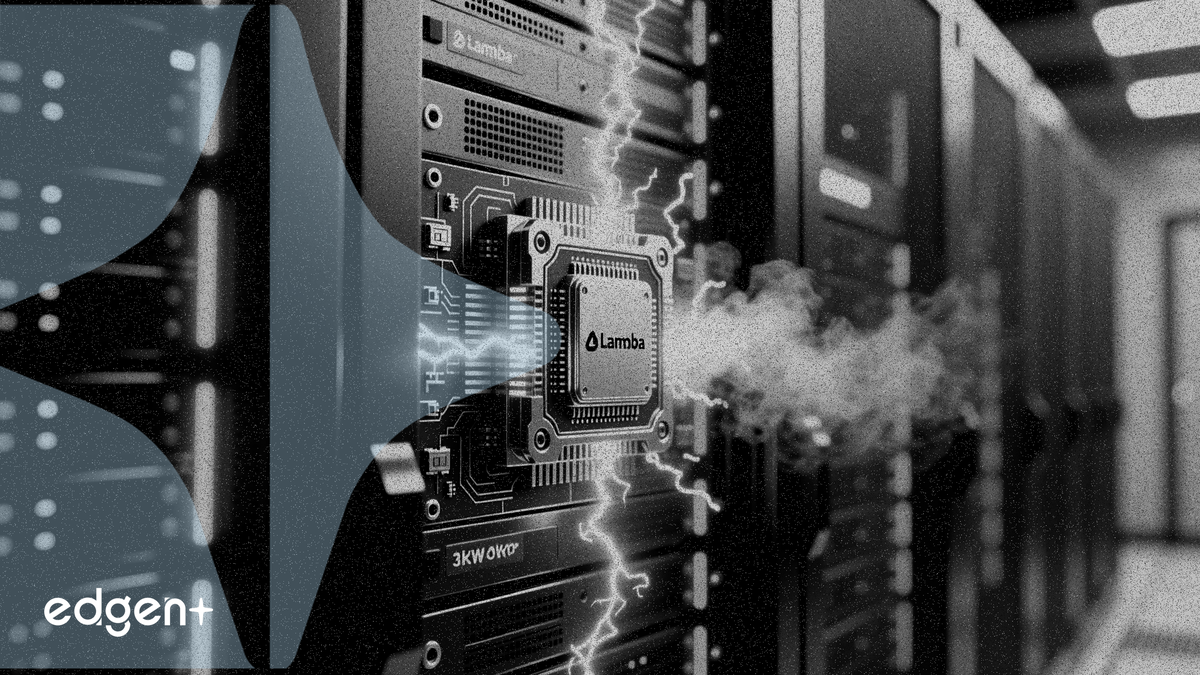
Nvidia's first co-packaged optics switch has moved from engineering sample to production deployment, cutting switch power by 3kW per unit and freeing capacity for more than 3,000 additional GPUs at scale.
Nvidia's silicon photonics bet just got its first production proof point. The Quantum-X InfiniBand Photonics Q3450-LD switch, deployed at Lambda's GPU clusters, delivers 3.5x better power efficiency than conventional designs — a direct rebuttal to bearish analyst reports that sent optical stocks tumbling days earlier.
"Co-packaged optics cut switch power, reduce failure points, and deliver more tokens per watt," Nvidia's AI Infrastructure team said in a video showcasing the deployment. Lambda, CoreWeave, Meta, Microsoft and Oracle Cloud Infrastructure are among the first adopters.
The 4U switch replaces traditional pluggable transceivers with optical components baked directly into the package, supporting 144 ports of 800G InfiniBand for 115.2 Tbps of non-blocking bandwidth. A standard switch draws roughly 7 kW; the CPO version draws 3.95 kW, saving 3.05 kW per unit. At a 41,472-GPU cluster scale — 1,440 CPO switches — that translates to 4,392 kW of freed power, enough to run an additional 3,137 GPUs, according to Lambda's calculations. The switch also eliminates 655,000 discrete transceiver modules that each represent a potential failure point in a 128,000-GPU data center.
The deployment lands at a moment of maximum uncertainty. SemiAnalysis on June 9 cut its Nvidia CPO switch shipment estimates and claimed the company's native 800V DC power supply would not ship at scale until after 2028, triggering a selloff in US optical communications stocks. Nvidia's video response — showing a production switch running in a live cluster — directly challenges the bear case on CPO readiness. But the 800V power timeline remains contested: Morgan Stanley said Nvidia told them the racks will be production-ready by the third quarter of 2026, while SemiAnalysis sees mass volume as years away.
The Manufacturing Bottleneck That Isn't Going Away
Even as Nvidia demonstrates CPO deployment, the supply chain constraints that gave bears ammunition remain real. TSMC's photonic integrated circuit yield sits at 50 percent to 60 percent, according to Morgan Stanley, and downstream assembly yields are even worse — 20 percent to 50 percent. The bank expects global optical engine shipments of just 6 million to 7 million units in 2027, far below the 20 million to 30 million the market had anticipated. The 2026-to-2028 period will see pluggable transceivers, CPO and copper interconnects coexisting, Morgan Stanley said.
For Nvidia, owning the networking layer deepens its competitive moat. The company already dominates AI compute with its GPUs; adding optical interconnects makes it harder for customers to mix and match components from rivals. But co-packaged optics introduces manufacturing complexity that pluggable transceivers avoid, and with five major companies deploying simultaneously, any systemic issue would ripple across the industry rather than being contained to a single operator.
What the Power Savings Mean at Scale
Lambda's framing — "more tokens per watt" — captures the economic logic. In a GB300 NVL72 cluster with 576 GPUs, 12 CPO switches free 37 kW, enough for 26 additional GPUs. At 4,608 GPUs, 100 switches free 305 kW for 217 extra GPUs. At 10,368 GPUs, 216 switches free 658 kW for 470 extra GPUs. The savings compound because networking power in a three-layer cluster now accounts for 86 percent of Lambda's back-end fabric consumption, the company said.
Investor Takeaway
Nvidia shares trade at roughly 35x forward earnings. The CPO deployment video stabilizes the narrative around silicon photonics readiness, but the 800V power supply timeline — and the unresolved gap between "production-ready" and "mass volume" — keeps a cloud over the optical supply chain. Delta Electronics is expected to be the first manufacturer of the 800V racks, with initial deliveries to North American hyperscalers in the fourth quarter of 2026, though volumes will be limited, Morgan Stanley said. The next milestone is whether Nvidia can demonstrate that CPO manufacturing yields improve fast enough to meet the demand its own product roadmap implies.
This article is for informational purposes only and does not constitute investment advice.