
The selloff in US memory chip stocks cascaded into Asia on Thursday, sending South Korea's KOSPI down 7% and dragging the broader semiconductor complex lower.
The selloff in US memory chip stocks cascaded into Asia on Thursday, sending South Korea's KOSPI down 7% and dragging the broader semiconductor complex lower.
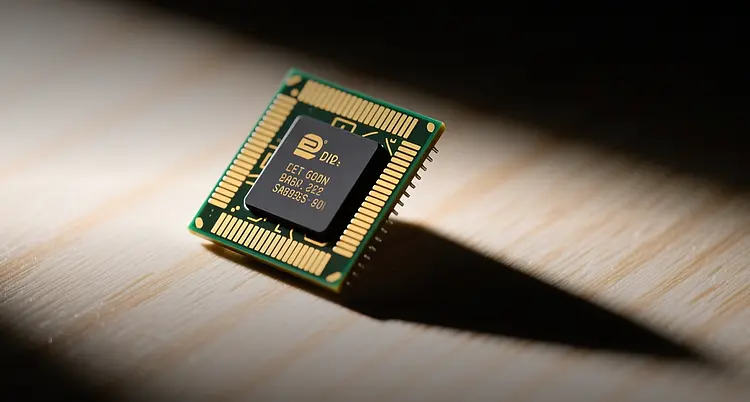
Micron Technology Inc. shares fell more than 9% on Wednesday, extending a rout that erased more than $50 billion in market value from the memory chip sector and spilled into Asian markets as investors questioned whether AI-driven demand can sustain the industry's pricing power.
"The concern is that the memory cycle is peaking faster than expected," said John Vinh, an analyst at KeyBanc Capital Markets who maintains an Overweight rating on Micron with a $1,600 price target. "While near-term pricing remains strong, the risk of capacity additions and demand normalization is rising."
Micron dropped 9.4% on Wednesday, bringing its two-day decline to more than 12%. The VanEck Semiconductor ETF, which surged 72% in the first half, fell 4.7%. The selloff accelerated Thursday in Asia, where South Korea's KOSPI plunged as much as 7%, with Samsung Electronics Co. and SK Hynix Inc. each falling more than 8%. The Korea Exchange temporarily suspended program selling after the steep drop in futures.
The rout threatens to unwind a historic rally in memory stocks. Micron had risen more than 230% this year and more than 850% over the past 12 months, reaching a $1 trillion market cap before the selloff. The question now is whether the industry's cyclical dynamics — tight supply, soaring average selling prices, and capacity shifts toward high-bandwidth memory — are beginning to reverse.
The selloff was triggered by a combination of profit-taking after a record first half and a class-action lawsuit filed in the US alleging Micron, Samsung and SK Hynix conspired to restrict production of conventional DRAM chips to inflate prices. The complaint claims the three companies, which control roughly 90% of the global DRAM market, shifted manufacturing capacity toward higher-margin HBM used in AI servers while reducing output of mainstream DDR3 and DDR4 memory. Prices for conventional DRAM have climbed roughly 700% over the past four years, according to the plaintiffs. During the mid-2000s, Samsung and Hynix pleaded guilty in a US Department of Justice investigation into DRAM price fixing, paying criminal fines of $300 million and $185 million, respectively.
Capacity Concerns Weigh on Pricing Outlook
Beyond the legal overhang, investors are grappling with signs that the memory shortage may be easing. SK Hynix's decision to reallocate some HBM manufacturing capacity back to standard DRAM production suggests the tight supply that has driven ASPs higher could moderate into year-end. Micron's own guidance points to slowing margin expansion — the company guided for a 6.1 percentage point increase in gross margins in Q2, but only 1.4 points in Q3 — signaling that the peak of the cycle may be near.
Micron has sought to insulate itself from the downturn by locking in long-term customer agreements with minimum pricing provisions. Those contracts, which cover about 40% of revenue and represent $100 billion in committed revenue with $22 billion in customer deposits, are designed to keep gross margins above previous cyclical peaks. Management believes it can sustain gross margins of 70% to 75%, according to UBS analyst Timothy Arcuri, who maintains a Buy rating with a $1,625 price target. That compares with Micron's previous peak of about 62% in 2018 and the roughly 85% reported in its latest quarter.
For investors, the selloff presents a test of whether memory stocks can decouple from their historical boom-bust cycle. Micron shares trade at roughly 8x forward earnings, a discount to the broader semiconductor sector, reflecting the market's skepticism that the current pricing environment is sustainable. KeyBanc's Vinh noted that while meaningful capacity additions are not expected until 2027, the risk of demand normalization — particularly as end-markets for PCs and smartphones remain weak — could pressure ASPs sooner. The average Wall Street price target for Micron stands at $1,543, implying roughly 20% upside from current levels, but the path to that target depends on whether the industry can avoid the oversupply that has historically followed every pricing boom.
This article is for informational purposes only and does not constitute investment advice.
