Huawei is betting its AI future on efficiency over scale, releasing a sparse-activation large model and an agent-first operating system in a single week.
Huawei is betting its AI future on efficiency over scale, releasing a sparse-activation large model and an agent-first operating system in a single week.
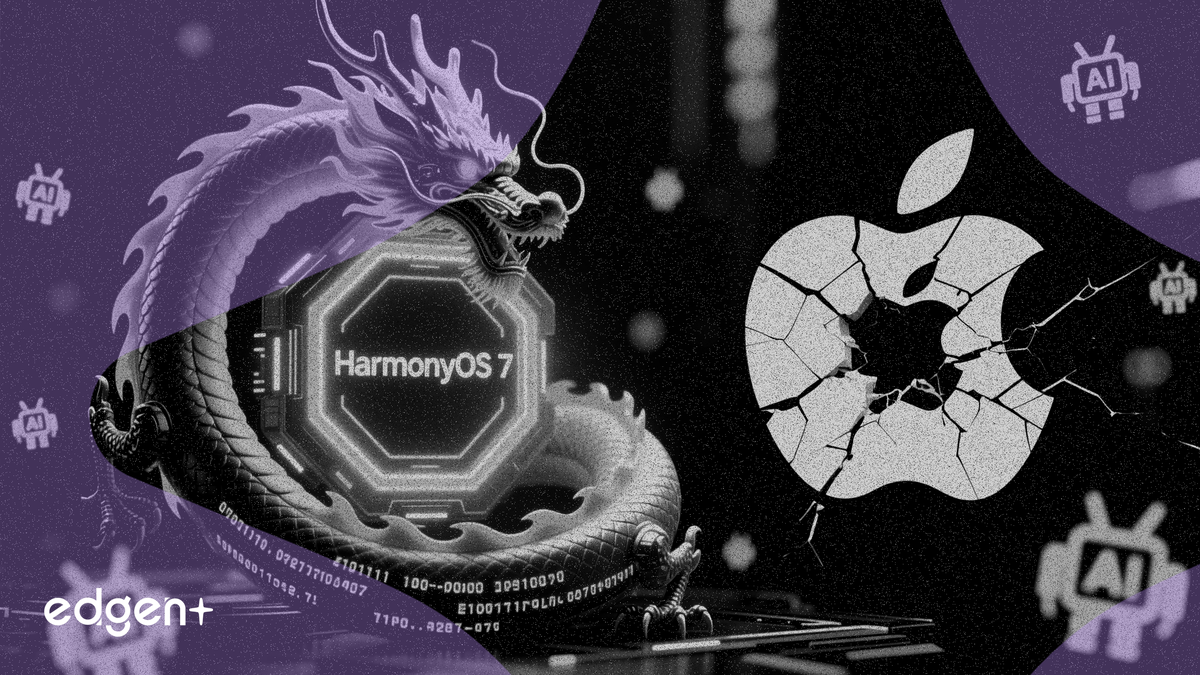
Huawei unveiled HarmonyOS 7 with an agent-native architecture and openPangu 2.0, a sparse-activation large model that prioritizes inference efficiency over raw parameter count, at its annual developer conference on June 12.
"In my dictionary, there is no second place — only first," Richard Yu Chengdong, chairman of Huawei's Consumer Business Group, said at the event. Yu, who took over the Pangu model team in September 2025, acknowledged the company had fallen behind after being an early pioneer in large language models.
openPangu 2.0 comes in two versions: the Pro model with 505 billion total parameters but only 18 billion activated per inference, and the Flash variant with 92 billion total and 6 billion activated. Both support a 512,000-token context window. The sparse design reduces compute load, enabling deployment across a wider range of hardware — a deliberate choice given Huawei's limited access to advanced chips.
The strategy reflects a fundamental constraint: Huawei cannot match U.S. rivals on training compute. Yu acknowledged that American companies have trained trillion-parameter models using abundant GPU supply, while Huawei's Ascend chips are largely allocated to external customers. By focusing on inference efficiency and on-device AI, Huawei is betting that the next phase of the AI race — deployment at the edge — plays to its strengths in hardware-software integration.
The Agent Architecture Bet
HarmonyOS 7 introduces what Huawei calls an "agent-friendly" system architecture, designed to let AI agents operate across applications and devices autonomously. The upgraded HarmonyOS Agent Framework 2.0 opens more than 20 system-level AI capabilities to developers, including graphical user interface control — a first for the platform.
The system agent XiaoYi has been upgraded from a voice assistant to a system-level intelligence layer capable of understanding context, remembering past interactions, and executing complex multi-step tasks. Huawei said XiaoYi can now generate personalized marathon training plans by cross-referencing health data with calendar schedules, or remotely locate and send files across connected devices. The company claims a 90 percent task execution success rate for its agent framework.
More than 2,000 specialized AI agents are already integrated into the ecosystem, according to Huawei. That positions HarmonyOS 7 as a direct competitor to Apple's iOS 27, which overhauled Siri with AI capabilities but remains unavailable in mainland China due to regulatory restrictions — creating a window for Huawei to capture domestic users.
Chip Constraints Shape the Strategy
The sparse-activation approach in openPangu 2.0 is not purely a technical choice — it is a necessity born of geopolitics. U.S. sanctions block Huawei from accessing advanced extreme ultraviolet lithography equipment from ASML, limiting its foundry partner SMIC to deep ultraviolet lithography for chip production.
Huawei's upcoming Kirin 9050 chip, expected to debut in the Mate 90 series this September, introduces LogicFolding architecture that stacks logic circuits vertically to improve transistor density without EUV equipment. Early internal testing reportedly shows performance comparable to chips produced on TSMC's 3-nanometer process, according to reports from the ISCAS 2026 conference in Shanghai. Huawei did not disclose the test methodology for these comparisons.
The Mate 90 is expected to be the first device shipping with a stable build of HarmonyOS 7, putting it in direct competition with Apple's iPhone 18 Pro expected around the same window. Huawei currently leads smartphone market share in China for early 2026, according to industry data.
What This Means for Investors
Huawei's dual push — a sparse-activation model optimized for edge deployment and an operating system built for AI agents — targets a market where Apple's AI features remain blocked in China and where U.S. cloud providers face geopolitical headwinds. If the Kirin 9050 delivers on its performance claims, it could narrow the gap with Qualcomm and MediaTek in the Android ecosystem while strengthening Huawei's position in China's premium smartphone segment.
The risk is execution. Huawei's 90 percent task success rate claim for its agent framework has not been independently verified, and the Kirin 9050's LogicFolding architecture faces yield challenges common to novel chip designs. Apple's iOS 27, meanwhile, could eventually receive Chinese regulatory approval, closing the window Huawei is exploiting.
This article is for informational purposes only and does not constitute investment advice.
