

Hitachi and Intel are combining industrial know-how with silicon to push physical AI into factories, energy grids, and mobility systems.
Hitachi and Intel are combining industrial know-how with silicon to push physical AI into factories, energy grids, and mobility systems.
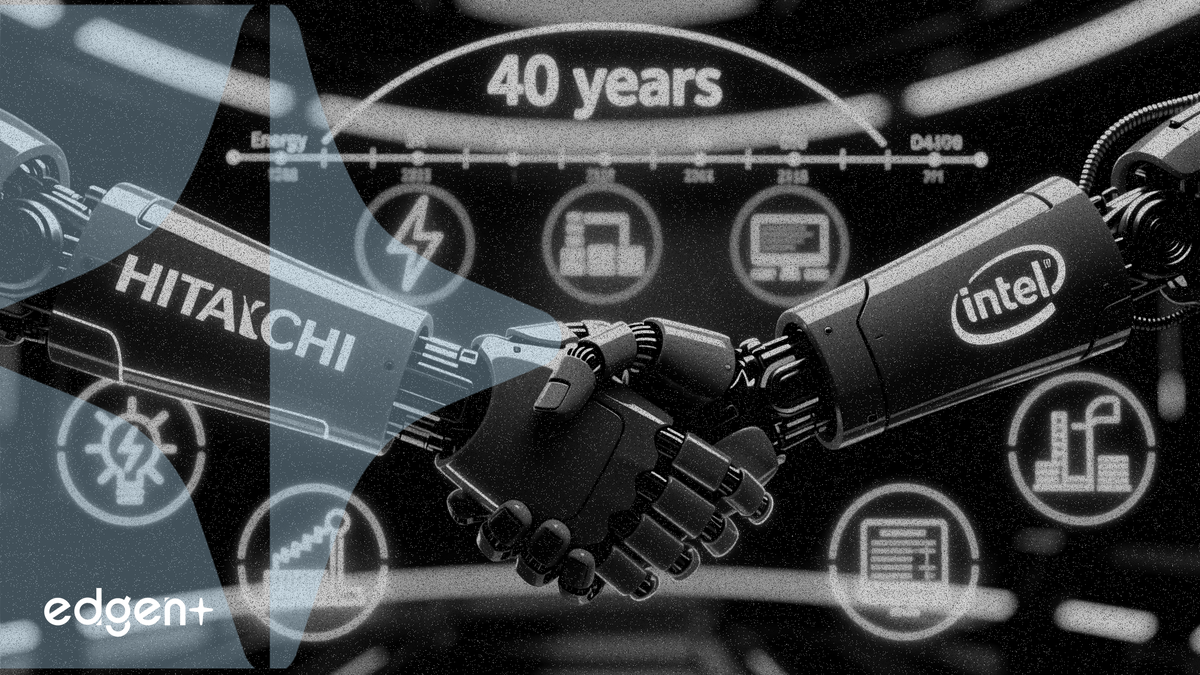
Hitachi Ltd. and Intel Corp. are joining forces across five technology pillars — from foundry tools to quantum computing — to deploy physical AI in manufacturing, energy, and mobility, the companies said June 5.
"Building on more than 40 years of trust with Intel, we are delighted to launch a comprehensive strategic collaboration," Toshiaki Tokunaga, President and CEO of Hitachi, said. "By combining Hitachi's IT, OT, and products with Intel's advanced computing capabilities, we are well positioned to advance the deployment of AI in mission-critical social infrastructure worldwide."
The partnership spans foundry tools — where Hitachi's ExTOPE platform uses data from its CD-SEMs and etching systems for predictive diagnostics to improve semiconductor yield — quantum computing co-development between R&D teams, energy optimization via Hitachi's HMAX Energy deployed inside Intel's fabs, custom silicon, edge-AI applications, and factory automation. Intel will supply high-voltage silicon chips to improve Hitachi's power systems.
For Intel, the deal extends its push beyond chip sales into full systems-level AI infrastructure, a strategy CEO Lip-Bu Tan is betting on to compete with Nvidia Corp. in the $200 billion-plus AI chip market. Hitachi, with FY2025 revenue of 10.6 trillion yen ($70 billion) and about 290,000 employees, gains access to Intel's advanced computing platforms to modernize its industrial customer base.
Physical AI Targets Factory Floors, Not Just Data Centers
The collaboration targets what Intel calls "physical AI" — systems embedded in robots, autonomous machines, and industrial equipment that interact with the physical world. This contrasts with the generative AI boom centered on data centers, where Nvidia's H100 and B200 GPUs dominate. Intel's strategy, showcased at Computex alongside partners Foxconn and SambaNova, emphasizes rackscale inference systems that can mix different accelerators, including Intel's Xeon processors with Nvidia GPUs.
Foundry Tools and Quantum Create Cross-Pollination
The foundry-tools pillar is particularly strategic. Hitachi's metrology systems and etching tools are used in semiconductor manufacturing lines worldwide, including at TSMC and Samsung. By feeding data from these tools into Intel's manufacturing via the ExTOPE platform, the partnership could improve chip yields and shorten time to market — a critical advantage as Intel pursues its 18A process node for the Xeon 6+ processors. On quantum computing, the companies said R&D teams will co-develop technologies, though no timeline was disclosed.
Intel shares trade at about 25 times forward earnings, above the analyst consensus target of $89.32, according to Simply Wall St. The partnership with Hitachi adds an industrial distribution channel that pure semiconductor rivals lack, but revenue contribution is unlikely before 2027. Hitachi's stock on the Tokyo Stock Exchange has not yet reacted to the announcement.
This article is for informational purposes only and does not constitute investment advice.
