

AMD's server processor market share hit a record 33.2% in the first quarter, marking the latest milestone in its challenge to Intel's data center dominance.
AMD's server processor market share hit a record 33.2% in the first quarter, marking the latest milestone in its challenge to Intel's data center dominance.
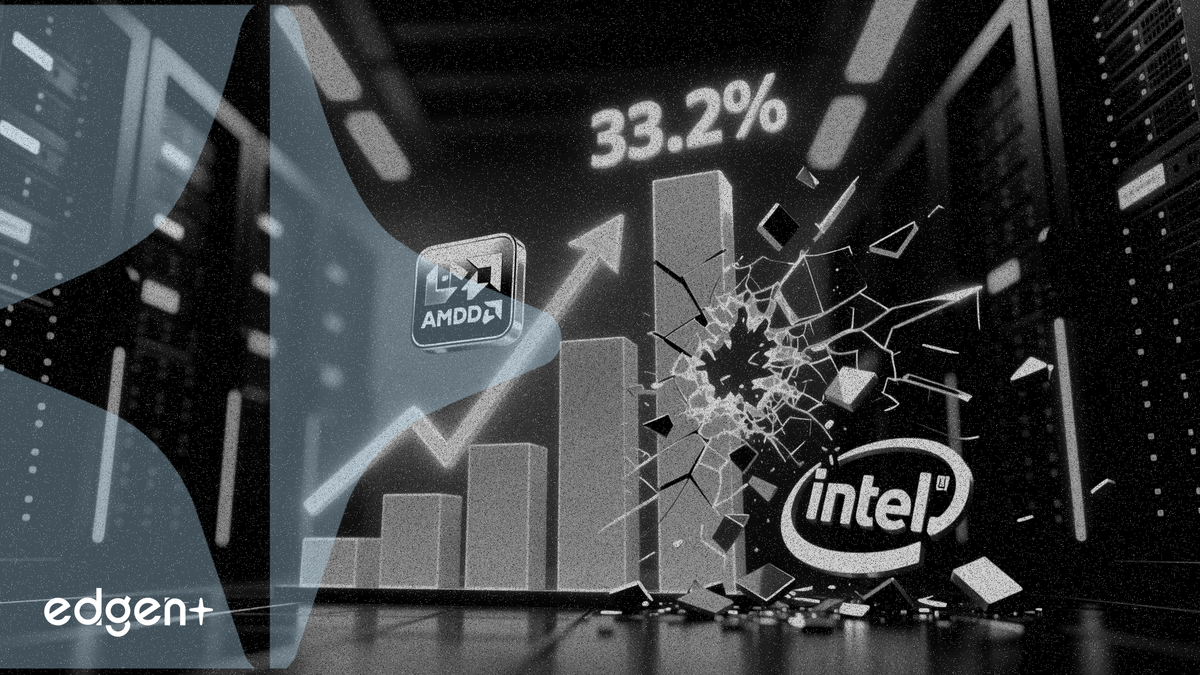
AMD's server processor market share hit a record 33.2% in the first quarter, marking the latest milestone in its challenge to Intel's data center dominance.
AMD's server processor market share reached 33.2% in the first quarter, a record high that pushed shares up more than 4% in pre-market trading on Monday, according to a market research firm.
"AMD's first-quarter server processor sales grew particularly strong, driven by demand from cloud operators upgrading data center infrastructure," the research firm said in its report. The gain extends a multi-year trend of AMD taking share from Intel in the lucrative server CPU market.
The milestone comes as AMD's Turin family of server chips, built on TSMC's 4nm and 3nm process nodes, has won design wins at major cloud providers including Amazon Web Services and Microsoft Azure. AMD's data center segment revenue has grown for five consecutive quarters, outpacing the broader server market.
The 33.2% share threshold pushes AMD past the one-third mark in a market Intel dominated with more than 90% share as recently as 2017. Every percentage point of server market share translates into roughly $400 million in annual revenue, based on industry estimates of the $140 billion server CPU market.
AMD's ascent has reshaped the competitive dynamics of the data center chip industry. Intel's server processor share has fallen to roughly 65%, down from 80% as recently as 2021, as the company struggled with manufacturing delays on its 7nm and subsequent process nodes. Intel's foundry business, launched to manufacture chips for external customers, has yet to land a major AI chip customer.
The server CPU market is increasingly intertwined with the AI boom. While Nvidia dominates the market for AI accelerators, server processors remain essential for running general-purpose workloads, managing data flow, and coordinating AI training clusters. AMD's EPYC processors have gained traction in part because they offer more cores per socket and lower total cost of ownership than comparable Intel Xeon chips, according to published benchmarks.
AMD's stock has risen roughly 25% year to date, giving the company a market capitalization of about $280 billion. The shares trade at approximately 28 times forward earnings, a discount to Nvidia's 35 times multiple but a premium to Intel's 18 times, reflecting the market's assessment of their respective growth trajectories.
The company faces headwinds, however. The U.S. Department of Commerce recently tightened chip export restrictions, requiring export licenses for AMD and Nvidia AI chips sent to Chinese subsidiaries located outside China, potentially limiting AMD's addressable market. AMD also faces renewed competition from Intel, which launched its Granite Rapids server processors earlier this year and has promised to regain share.
This article is for informational purposes only and does not constitute investment advice.
