

Amazon's AI chief predicts the first commercially useful quantum computers will arrive within seven years, placing the company in the middle of a contentious industry timeline debate.
Amazon's AI chief predicts the first commercially useful quantum computers will arrive within seven years, placing the company in the middle of a contentious industry timeline debate.
Amazon's AI chief predicts the first commercially useful quantum computers will arrive within seven years, placing the company in the middle of a contentious industry timeline debate.
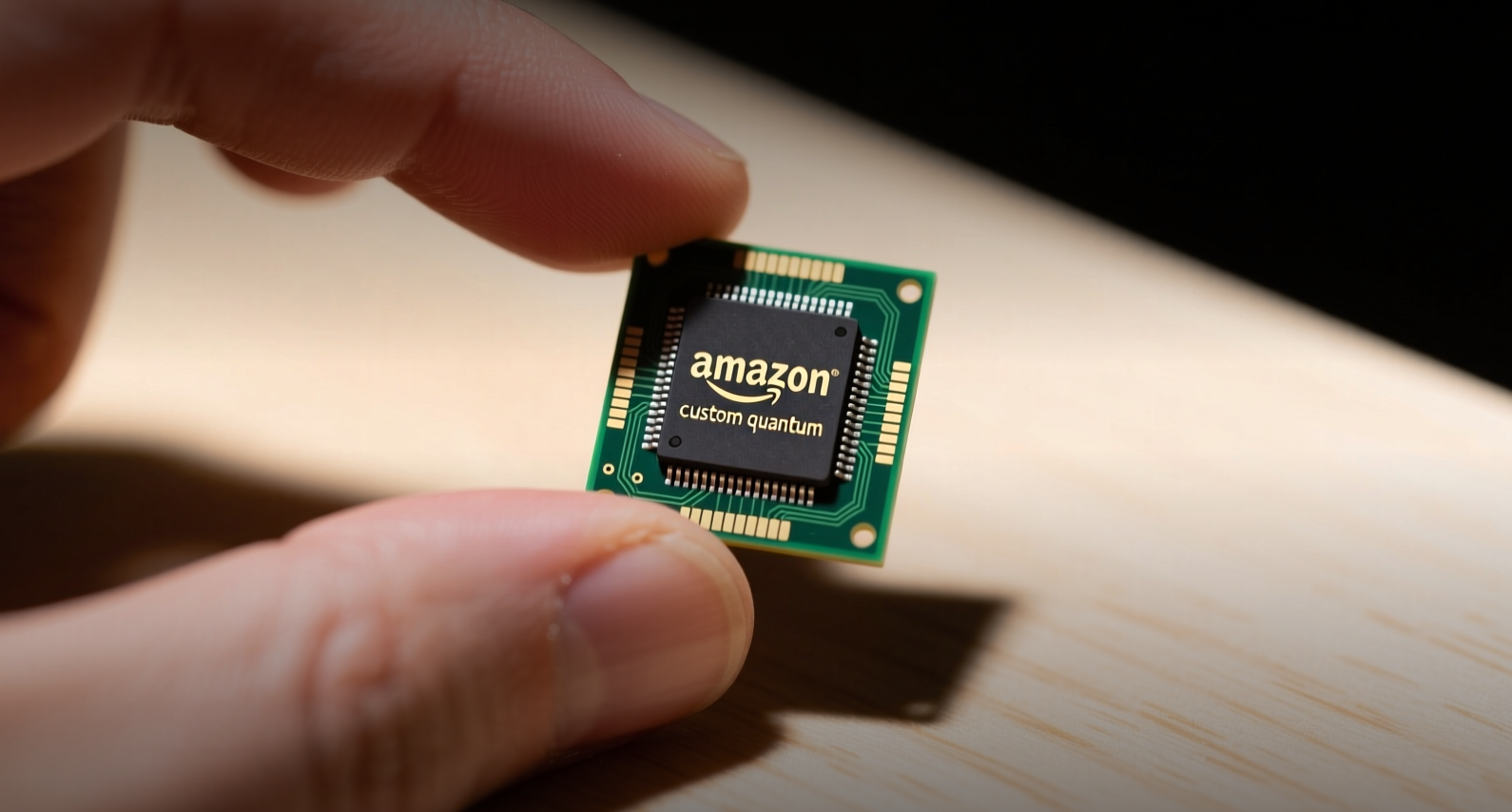
Amazon's top AI executive said the first commercially useful small-scale quantum computers will arrive in five to seven years, a forecast that lands between the most bullish and most skeptical timelines in the industry.
"I actually do believe, over the next five-to-seven years, we're going to start to see the first commercially useful small-scale quantum computers," Peter DeSantis, senior vice president at Amazon overseeing AI models, chips and quantum computing, told CNBC on Wednesday. "From there, we're going to see something that looks a lot like Moore's Law, where they're going to get bigger and bigger every year, and they're going to be able to tackle more and more interesting problems."
DeSantis' timeline places Amazon between Google, whose quantum executive said in March last year that practical applications are five years away, and Nvidia CEO Jensen Huang, who said 15 years would "probably be on the early side" before walking back those comments. Microsoft has said it expects a commercially viable quantum machine by 2029. Amazon unveiled its Ocelot quantum chip last year, designed to address error correction — one of the biggest technical hurdles in the field.
"One of the misnomers is a quantum computer is going to be a faster computer, that's not it at all," DeSantis said. "A quantum computer is going to solve a very particular type of problem that isn't solved well today with a classic computer, and it's going to solve it much better." He identified chemistry and material science as the first applications, areas where classical computers cannot run high-fidelity simulations.
Quantum Timeline Pits Amazon Against Rival Forecasts
The divergence in industry timelines reflects the fundamental engineering challenges still facing quantum computing. Qubits, the quantum equivalent of classical bits, can exist as zero, one or something in between, but they are highly error-prone and require sophisticated error correction to perform useful calculations. Amazon's Ocelot chip specifically targets this problem, using what the company calls "cat qubit" architecture to reduce the overhead required for error correction.
The competitive landscape includes tech giants Microsoft, Google and IBM, along with a growing roster of startups. Amazon's approach differs from some rivals in that it offers quantum computing services through its AWS cloud platform — Amazon Braket — rather than requiring customers to purchase hardware directly. This model mirrors the company's broader strategy of renting compute capacity rather than selling chips, though CEO Andy Jassy said in April that Amazon could consider selling racks of its Trainium chips to third parties.
Amazon's AI Push Extends Beyond Quantum
DeSantis also addressed Amazon's position in the broader AI race, acknowledging the company has trailed OpenAI and Anthropic on frontier models. "I think it's a fair narrative that our models haven't been at the very frontier for the very largest, most demanding workloads," he said. Amazon released Nova2, its latest AI model, in December and has attracted about 50,000 customers. "Our aspiration is to have a model that people think about as one of the very most capable intelligent models out there," DeSantis said. "I'm not sure we're there yet with Nova2, but that's our aspiration."
Amazon's chip strategy under DeSantis includes the Trainium and Graviton families of custom semiconductors, which the company designs in-house — a model he compared to Nvidia. "We're one of a very few players who have the ability to design a chip, design the physical attributes of that chip, and then do the production of that chip," he said. Amazon currently rents compute capacity through AWS, with Anthropic among its biggest customers. DeSantis left the door open to selling Graviton chips to third parties as well, saying "today we're not thinking about deploying that outside of AWS, but who knows."
Amazon shares trade at about 22 times forward earnings. The company's quantum and AI chip investments represent a multiyear bet that in-house silicon can reduce its dependence on external suppliers while capturing more of the $200 billion-plus cloud computing market. If DeSantis' timeline holds, the first commercial quantum applications could begin generating revenue before the end of the decade.
This article is for informational purposes only and does not constitute investment advice.
