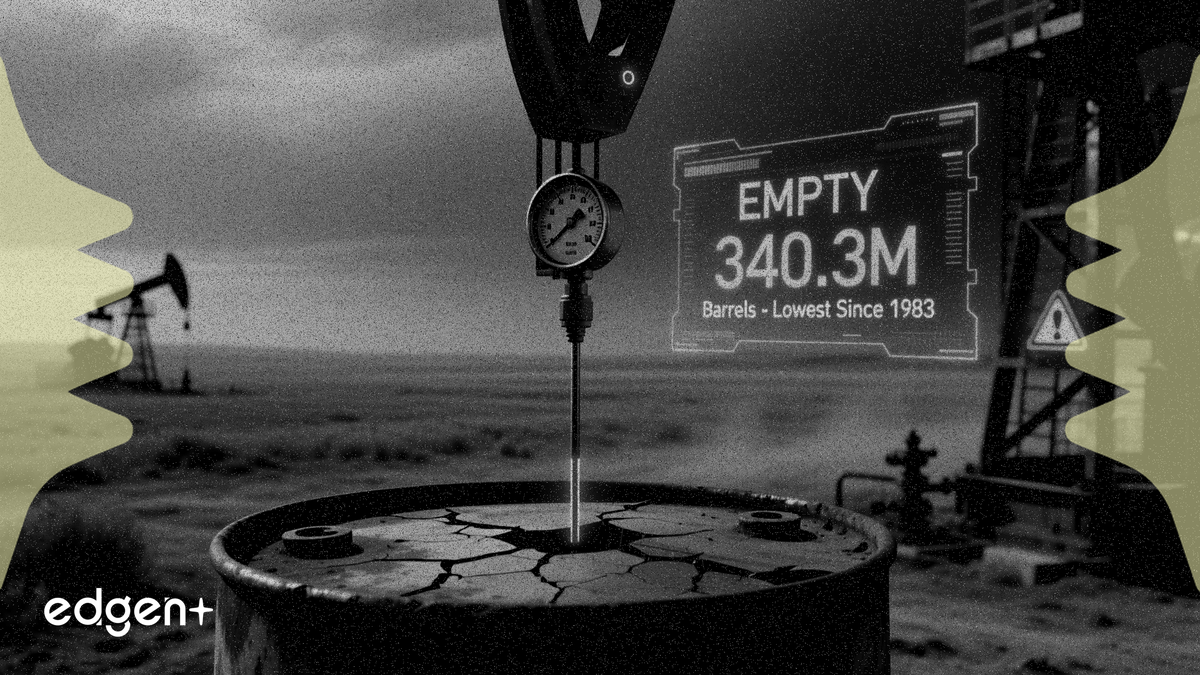
America's emergency oil stockpile has dropped to levels not seen since the Reagan administration was first filling it four decades ago.
The US Strategic Petroleum Reserve fell to 340.3 million barrels last week, the lowest since 1983, as the Trump administration's drawdowns to counter the Iran conflict accelerated the depletion of the nation's energy safety net.
"No matter where you stand politically, it's a remarkable statistic," said Patrick De Haan, head of petroleum analysis at GasBuddy.
The reserve lost 8.9 million barrels in the week ending June 12, according to Energy Department data released Monday. That undercuts the prior post-Cold War low of 346.8 million barrels set in July 2023 under the Biden administration. The SPR now holds less than half of its authorized capacity of about 714 million barrels.
The depletion leaves the US with its thinnest energy cushion in the modern era just as a tentative peace deal with Iran opens the Strait of Hormuz — but analysts warn that Asian demand for replenishing strategic reserves could keep crude markets tight for months.
How the reserve got here
The Trump administration announced in March it would release 172 million barrels over 120 days to stabilize global markets after the Iran conflict disrupted supply routes through the Strait of Hormuz. At the time, the reserve held about 415 million barrels, meaning current releases are roughly a third complete.
The drawdowns have accelerated sharply since the conflict began. About 50 million barrels have been pulled from the SPR since the start of the Iran war, with weekly withdrawals averaging around 9 million barrels. The total decline tied to the geopolitical crisis amounts to approximately 75 million barrels, an 18% drop in crude stocks.
The SPR was established in 1975 after the Arab oil embargo sent gasoline prices soaring and triggered panic buying at pumps across the country. It reached peak fill in 2009 and has been on a broadly downward trajectory since, punctuated by periodic releases during geopolitical crises.
President Joe Biden oversaw the largest release in the reserve's history — 180 million barrels in 2022 after Russia's invasion of Ukraine. He inherited about 638 million barrels when he took office in 2021 and left with roughly 394 million barrels in January 2025. The Biden administration said in 2024 it had replenished some of those withdrawals, but the reserve never recovered to pre-war levels.
The current 340.3 million barrel reading is comparable to July 29, 1983, when the reserve stood at 339.9 million barrels as the Reagan administration was still building it up for the first time. But the context is fundamentally different: US daily oil consumption has grown to about 21 million barrels, meaning the reserve now covers roughly 16 days of imports versus a much longer cushion in the 1980s.
What comes next
The Sunday announcement of a 60-day peace deal between the US and Iran includes reopening the Strait of Hormuz with no shipping tolls, which could ease supply constraints. But the Trump administration has not signaled any change to its planned 172 million barrel release program.
Bob McNally, president of Rapidan Energy Group, said countries across Asia — including China — will increase demand for crude to replenish their own strategic reserves depleted by the conflict and the Strait of Hormuz closure. That demand surge could offset any supply relief from the reopening, keeping upward pressure on WTI and Brent crude prices.
If weekly drawdowns continue at the current pace, the SPR could breach 300 million barrels before the end of summer, a level that would test the limits of America's energy security framework. The last time the reserve was that low, the US economy was half its current size and domestic oil production was a fraction of today's 13 million barrels per day.
This article is for informational purposes only and does not constitute investment advice.