
The US-Iran peace deal ending a 107-day conflict is set to lower oil prices, strengthen the rupee, and revive India's exports to West Asia, according to exporters and economists.
The US-Iran peace deal ending a 107-day conflict is set to lower oil prices, strengthen the rupee, and revive India's exports to West Asia, according to exporters and economists.
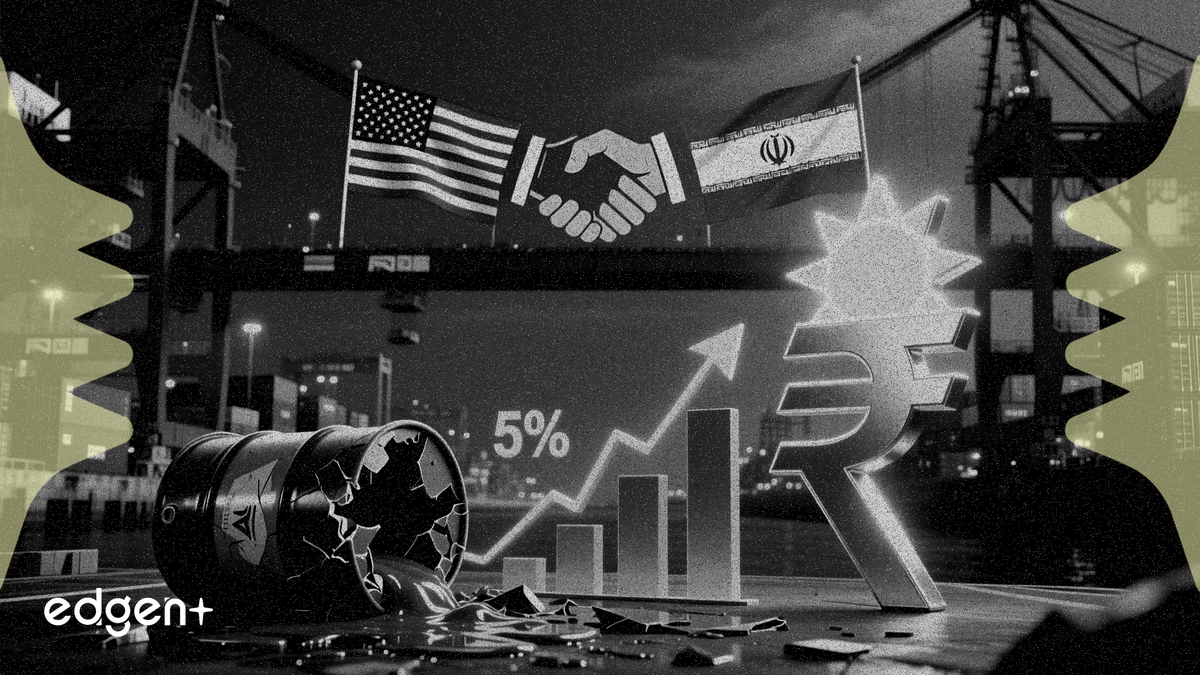
The US-Iran peace deal, scheduled for signing June 19 in Switzerland, pushed Brent crude below $84 a barrel and strengthened the rupee 0.7%, offering India relief from three months of elevated energy costs and trade disruption.
"The agreement brings immediate economic relief as the conflict exposed India's dependence on West Asia, from where it sources roughly 50% of its crude oil imports," said Ajay Srivastava, founder of the Global Trade Research Initiative.
Brent crude fell 4.8% to $83.11 a barrel on June 15, its lowest in about three months, while West Texas Intermediate dropped 5.2% to $80.47. The rupee opened at 95.32 against the dollar and touched an intraday high of 94.95 before closing at 95.11. Asian equities rallied, with Japan's futures climbing 2% and the S&P 500 gaining 1.5% to 7,543.
The reopening of the Strait of Hormuz, which handled about 21% of global crude transit before the war, could reduce India's import bill by billions of dollars monthly, ease wholesale inflation that hit 9.68% in May, and restore export flows that collapsed during the conflict.
Trade disruption runs deep
India's exports to West Asia dropped 57.95% to $3.5 billion in March, the steepest monthly decline in five months, while imports from Gulf countries fell 51.64%. Under normal conditions, India ships about $6 billion worth of goods to the region each month. The six Gulf Cooperation Council members — the UAE, Saudi Arabia, Qatar, Oman, Kuwait and Bahrain — are among India's largest trading partners, with bilateral trade reaching $178.7 billion in the 2024-25 fiscal year.
India depends on West Asia for roughly 70% of its liquefied petroleum gas supplies and nearly 90% of its liquefied natural gas imports, according to GTRI data. During the conflict, shipping disruptions through the Gulf forced Indian refiners to seek supplies from more distant markets, adding to import costs and pressuring the rupee.
"The end of war and hostilities will not only help in a quantum jump in India's exports but will throw open a host of new business opportunities," said Sharad Kumar Saraf, founder chairman of Technocraft Industries India. "The next two to three years will accelerate India's efforts for a Viksit Bharat."
Market relief and forward risks
Financial markets priced in a rapid normalization. Gold rose 1.4% to $4,280 an ounce as the dollar weakened, with the euro gaining 0.4% to $1.1608 and the pound advancing 0.3% to $1.3446. The Dow Jones Industrial Average hit an all-time high of 51,725, up 1%.
The memorandum of understanding, signed digitally by President Donald Trump, Vice President JD Vance and Iranian Parliament Speaker Mohammad-Bagher Ghalibaf, initiates a 60-day negotiation period focused on Iran's nuclear program. Iran's Revolutionary Guard published a 14-point list of terms that includes full lifting of the US naval blockade within 30 days and $24 billion in frozen funds released during the negotiation period — though a senior US administration official said Iran would receive none of the money until it demonstrates compliance.
Commerce Secretary Rajesh Agarwal said many trade-related challenges "could ease significantly if the peace deal holds and remains sustainable." The last time a comparable geopolitical disruption hit the Strait of Hormuz — during the 2019 tanker attacks — oil prices spiked 15% over six weeks before retreating as supply routes normalized.
This article is for informational purposes only and does not constitute investment advice.
