
Trump's abrupt cancellation of airstrikes on Iran sent Treasury yields tumbling and oil prices sliding as markets priced in a potential diplomatic resolution to the three-month conflict.
Trump's abrupt cancellation of airstrikes on Iran sent Treasury yields tumbling and oil prices sliding as markets priced in a potential diplomatic resolution to the three-month conflict.
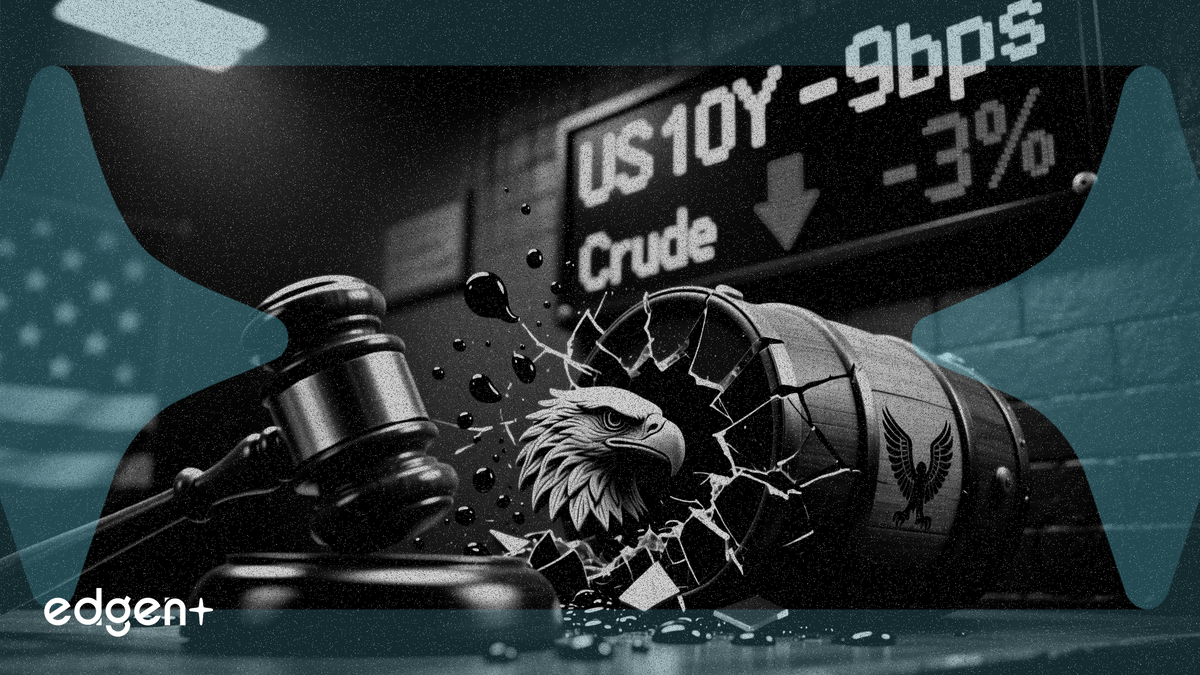
President Donald Trump canceled planned airstrikes on Iran on Thursday after claiming a "great settlement" was near, sending the 10-year Treasury yield down 9.12 basis points to 4.4611% and Brent crude 2.9% lower to $90.38.
"Trump has made so many threats that he has not carried through on and telegraphed on many occasions his strong desire to end this war as soon as possible, that I think Iran does not take these threats seriously," said Michael Eisenstadt, director of the Military and Security Studies Program at the Washington Institute for Near East Policy.
The U.S. 2-year yield dropped 8.13 basis points to 4.0619%, while West Texas Intermediate crude fell $2.32, or 2.6%, to settle at $87.71 a barrel. The moves reversed earlier gains after Trump threatened "bigger, more powerful" strikes and said the U.S. would seize Iran's Kharg Island oil terminal, which handles about 90% of Iran's crude exports. The yield crash occurred at 1:28 a.m. New York time, moments after Trump's Truth Social post announcing the cancellation.
The about-face — Trump's latest in a pattern of oscillating between escalation and diplomacy — leaves investors questioning whether a verifiable agreement exists. Iran's semi-official Fars news agency reported that Tehran had not approved any text, characterizing Trump's move as a tactical retreat. Trump said the naval blockade would remain "in full force and effect" until a signing, potentially as soon as this weekend in Europe with Vice President JD Vance in attendance.
A Pattern of False Dawns
Trump has claimed a deal with Iran is imminent more than 30 times since the war began Feb. 28, only for negotiations to collapse. The latest iteration involves a memorandum of understanding that Trump described as "a little conceptual" but said would ensure Iran does not possess a nuclear weapon. He said the agreement had been approved by a coalition including the U.S., Israel, Saudi Arabia, the UAE, Qatar, Turkey, Pakistan, Bahrain, Kuwait, Jordan and Egypt.
Israeli Prime Minister Benjamin Netanyahu's office said Trump committed during a phone call to ensuring any final agreement would include the removal of enriched nuclear material, limits on missile production and an end to Iran's support for proxy groups. Israel is not a party to the memorandum but has been fighting Iranian-backed Hezbollah in Lebanon.
The disconnect between Trump's optimism and on-the-ground reality was underscored by Iran's chief negotiator Mohammad Bagher Ghalibaf, who warned that "wrong strategies and impulsive decisions will reset the entire board for the worse, explode energy infrastructure and markets and create an endless quagmire."
Oil Markets and the Strait of Hormuz
The Strait of Hormuz, through which about 20% of global oil and gas shipments pass, has been a central flashpoint. Iran announced its closure Wednesday, though the U.S. military said commercial ships continued to transit. Trump said the strait would reopen immediately upon signing, perhaps as soon as Saturday.
Brent futures had surged earlier this week after two consecutive nights of U.S. strikes, which began after Iran shot down a U.S. Apache helicopter near the strait on Monday. The U.S. has disabled nine vessels attempting to violate its blockade since April 13 and redirected 135 ships that complied, according to Central Command. Three Indian sailors died in one strike on a tanker off Oman, prompting New Delhi to urge Washington to stop firing on ships.
The last time a U.S. administration pursued a dual-track strategy of military strikes and nuclear negotiations with Iran was the 2015 JCPOA talks, which took two years to finalize. The current conflict has already lasted more than 100 days, with U.S. defense costs mounting as Trump urged Congress to approve a $350 billion Pentagon funding package to "supercharge" ammunition stockpiles and fund projects including the Golden Dome missile defense system.
Democrats have criticized the administration's approach. Senate Minority Leader Chuck Schumer called the war a "fiasco," while Sen. Richard Blumenthal warned the conflict could "spiral out of control" like World War I. The House passed a bipartisan war powers resolution last week to end U.S. involvement. Sen. John Hoeven, a North Dakota Republican, cautioned that any deal must be enforceable, saying "they never, ever keep their word" about Iran.
This article is for informational purposes only and does not constitute investment advice.
