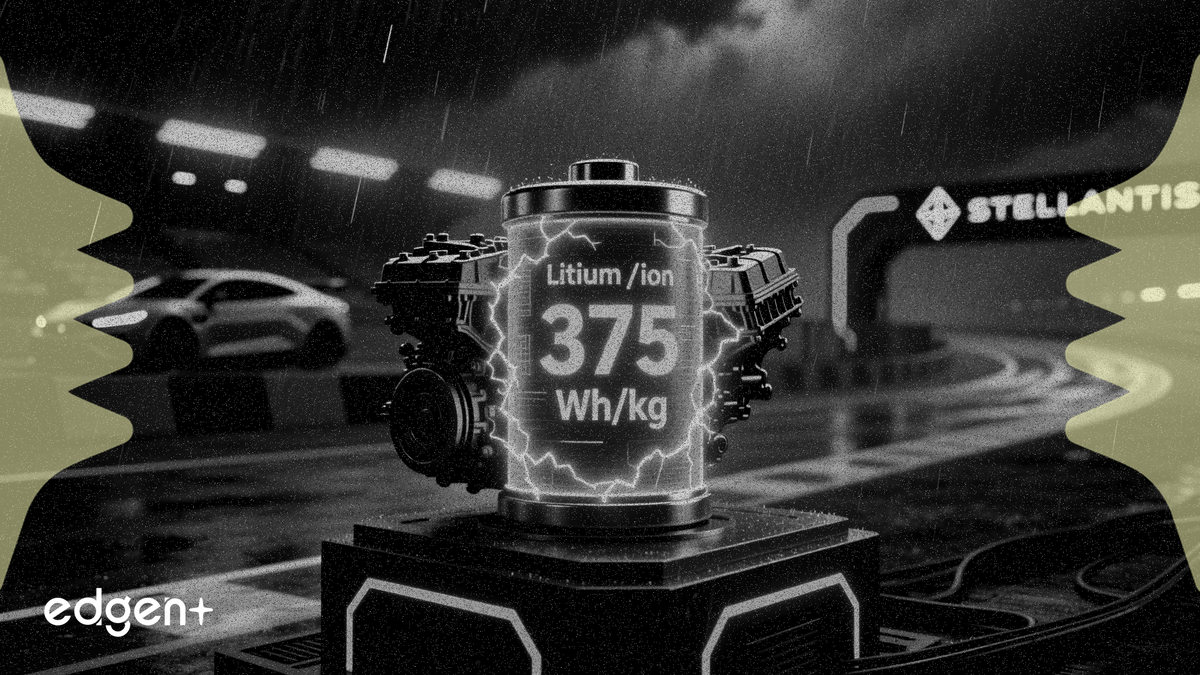
Factorial's solid-state cells have moved from the lab to the road, powering a Dodge Charger Daytona in the first North American automotive integration of the technology.
Stellantis has begun road testing a Dodge Charger Daytona equipped with Factorial's solid-state battery cells, marking the first automotive integration of the technology in North America and a milestone toward commercializing advanced energy storage.
"Battery development is a balancing act. It's not enough to optimize a single metric. We need a system that delivers real benefits in a real vehicle," Ned Curic, Stellantis chief engineering and technology officer, said.
The FEST cells, demonstrated in 2025 at 375 watt-hours per kilogram, can charge from 15 percent to 90 percent in 18 minutes and operate reliably from minus 30 degrees Celsius to 45 degrees Celsius. Stellantis engineers designed a patented mechanical architecture to integrate the solid-state cells into the existing battery pack, adapting control systems to meet automotive safety and durability requirements.
The milestone brings solid-state technology closer to production at a time when automakers are racing to improve range, charging speed and cost. Factorial, which trades on the Nasdaq under the ticker FAC, has positioned its FEST chemistry as compatible with existing lithium-ion manufacturing lines, a feature Curic said gives "a critical path to scale this technology."
The road-testing program will validate pack performance under real-world charging and driving conditions, building on earlier cell-level validation. Factorial's cells use a proprietary solid electrolyte that replaces the liquid electrolyte found in conventional lithium-ion batteries, enabling higher energy density and improved safety by reducing fire risk.
The achievement puts Stellantis alongside Toyota and QuantumScape in the race to commercialize solid-state batteries, which the industry views as the next advance in EV performance. Toyota has targeted production of solid-state cells for hybrid vehicles as early as 2027, while QuantumScape, backed by Volkswagen, has shipped prototype cells to automakers for testing. Samsung SDI and LG Energy Solution are also developing their own solid-state technologies.
For Stellantis, the parent of Jeep, Ram and Peugeot, the solid-state push supports its goal of offering battery-electric vehicles across all its brands. The company has invested in Factorial since 2021 and expanded the partnership in 2024 with a joint development agreement.
Factorial trades as a development-stage company with no commercial revenue, making the Stellantis road test a key de-risking event. If the technology proves viable at scale, it could pressure incumbent battery suppliers such as CATL and LG Energy Solution, which dominate the liquid-electrolyte lithium-ion market. Stellantis shares, listed on the New York Stock Exchange, have yet to price in a solid-state premium, leaving room for upside if the road-testing program delivers on its performance targets.
This article is for informational purposes only and does not constitute investment advice.