
Key Takeaways:
- SpaceX shares surged 30% on debut after raising a record $75 billion.
- Elon Musk became the world's first trillionaire as SPCX hit $175.
- Robinhood reported record-breaking retail trading traffic on listing day.
Key Takeaways:
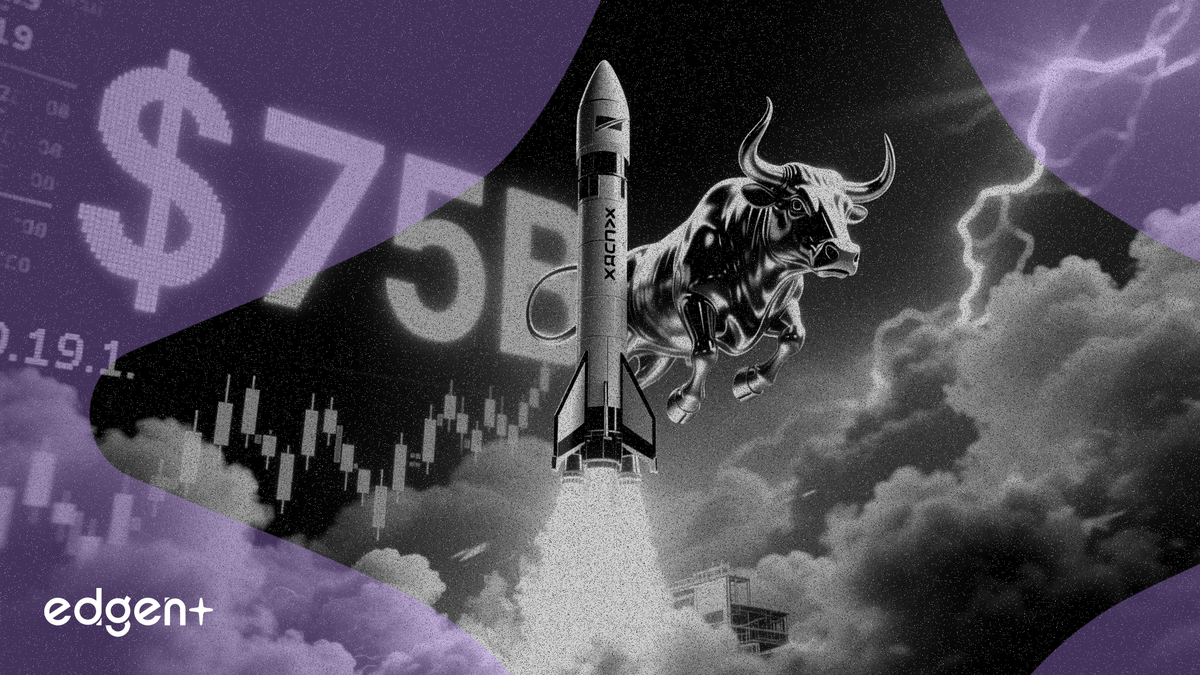
SpaceX shares surged as much as 30% in their Nasdaq debut Friday after the rocket and AI company raised a record $75 billion in the largest initial public offering in history, vaulting Chief Executive Officer Elon Musk to the status of the world's first trillionaire.
"The sheer scale of retail participation in this IPO is unprecedented — we've never seen this level of individual investor demand for a single listing," said Tom Brennan, an IPO and M&A analyst at Edgen. "SpaceX allocated 30% of shares to retail, roughly three to six times the typical allocation, and the trading platforms are feeling the strain."
SPCX opened at $150 per share, above the $135 IPO price set Thursday evening, and climbed to about $175 in midday trading, giving the company a market capitalization of roughly $2.1 trillion — surpassing Tesla's $1.4 trillion valuation. The offering of 555.6 million shares valued the company at $1.77 trillion at the IPO price, dwarfing every prior listing. Robinhood said it saw "record-breaking" traffic on its trading platform in the hours after the debut.
The listing marks a watershed moment for the private-to-public transition in the aerospace and AI sectors, with OpenAI and Anthropic — valued at $852 billion and $965 billion, respectively — having filed confidential S-1 documents for their own potential offerings. SpaceX's S-1 filing showed the company posted a $4.9 billion loss on $18.7 billion in revenue in 2025, with Starlink serving as the primary financial engine. The satellite broadband network has more than 10,000 satellites in orbit and 10 million subscribers across 164 countries, generating $1.19 billion in operating profit in the first quarter alone. However, SpaceX still burned $1.94 billion in Q1 operations as capital spending on Starship, the xAI merger, and orbital AI data centers ramps up.
Musk holds 42% of SpaceX equity and 82% of voting control through Class B shares carrying 10 votes each, compared with one vote for Class A shares held by public investors. The company qualifies as a "controlled company" under Nasdaq rules and intends to rely on corresponding governance exemptions. Morningstar analysts Nicolas Owens and Suryansh Sharma said in a blog post that SpaceX has been "significantly overvalued," setting their own fair value estimate at $63 per share — roughly half the IPO price. "Investors will have opportunities to buy the stock at more attractive levels after the IPO," they wrote.
The IPO's success is expected to set the tone for a busy 2026 listing cycle. Wedbush Securities analyst Dan Ives said the listing "represents the first major test for public markets after years of muted IPO activity" and predicted an 80% chance of a SpaceX-Tesla merger in 2027. The combined entity would carry a valuation near $3 trillion. On the other side of the spectrum, an IPO flop could have thwarted investor enthusiasm for the wave of mega-cap tech listings expected to follow.
This article is for informational purposes only and does not constitute investment advice.
