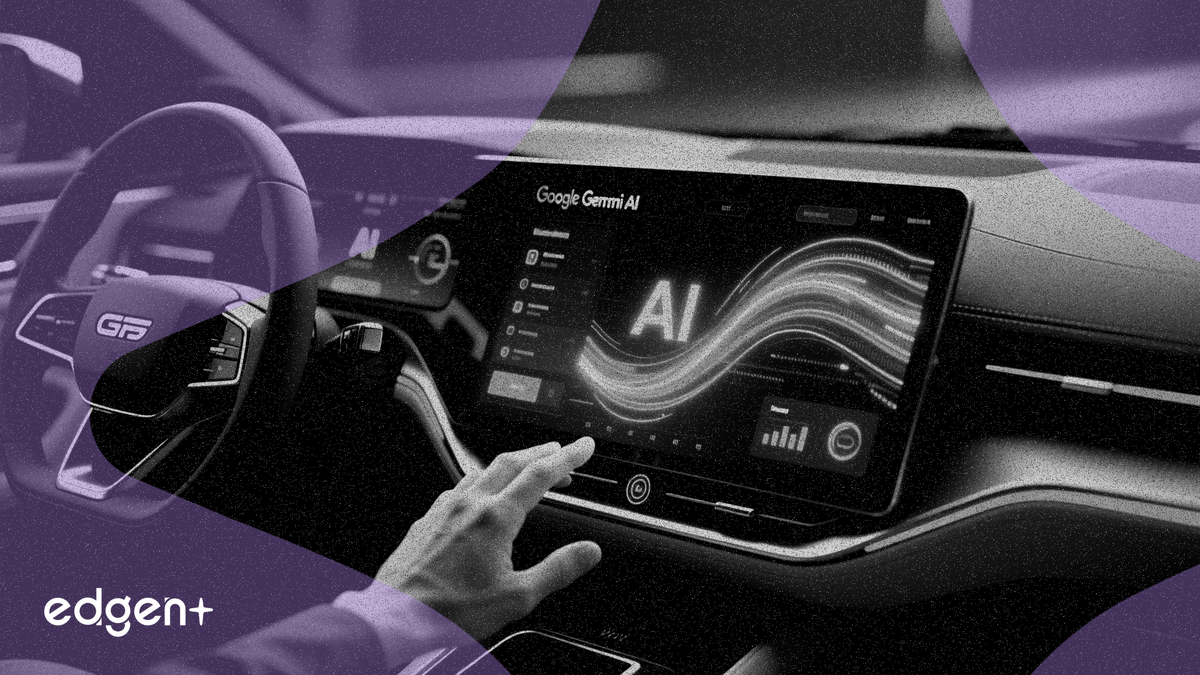
Google is deploying its Gemini artificial intelligence to 4 million General Motors vehicles, a move that directly targets the auto industry's most persistent customer complaint: clunky infotainment systems. The over-the-air update replaces the existing Google Assistant with a sophisticated conversational AI, potentially setting a new standard for in-car technology and challenging rivals like Apple and Tesla for dashboard dominance.
"They have context about previous conversations that they can bring up. They’re flexible in how you speak to them," Dave Richardson, GM's Senior VP of Software and Services, said, explaining Gemini's ability to handle natural language. "Ask for directions, then immediately follow with ‘Is there a good coffee shop on the way?’ Gemini maintains context across multiple requests without restarting the conversation."
The software update will be available for most 2022 and newer Chevrolet, GMC, Buick, and Cadillac models that are equipped with the "Google built-in" package. To receive the upgrade, owners must have an active OnStar connection, be signed into the Google Play Store on their vehicle, and use US English as the assistant language. The system integrates with installed apps like Spotify or YouTube, allowing for complex, single-sentence requests like "Find Italian restaurants near my destination with good reviews, then play something upbeat for the drive."
This integration is a significant step in the battle for the car's digital real estate. For GM, it's a crucial software enhancement as the company phases out Apple CarPlay and Android Auto from its new electric vehicles. For Google, it reinforces the company's broader AI strategy, which contributed to parent company Alphabet reporting a 22% revenue increase to $109.9 billion in the first quarter of 2026, according to CEO Sundar Pichai.
From Robotic Commands to Real Conversation
Infotainment systems are a notorious source of frustration for new car owners. Research from J.D. Power's 2024 study revealed that these systems cause nearly twice as many problems as any other vehicle component, with voice recognition leading the list of failures. Drivers report systems misinterpreting simple commands, failing to tune radio stations, or requiring rigid, unnatural phrasing to perform a task.
Gemini is designed to solve this by moving from a command-based structure to a conversational one. Instead of requiring the user to issue a series of separate, precise commands, the AI can understand multi-part requests and follow-up questions. This allows drivers to perform complex tasks like finding trailer-friendly parking for a truck or dictating a text message with emojis without taking their hands off the wheel.
The Competitive Dashboard
The GM rollout represents one of the largest deployments of advanced AI in the automotive sector, positioning Gemini as a direct competitor to Tesla's in-house AI, Grok. While analysts like Edward Loh at MotorTrend note that Grok is currently a top assistant, he stated that GM and Gemini are "well-positioned to challenge." While Volvo was the first automaker to integrate Gemini, GM's deployment across 4 million vehicles signals a major push for market penetration.
The move also serves as a high-profile replacement for the popular phone-mirroring apps, Apple CarPlay and Android Auto, which GM is eliminating from its future EVs. By offering a powerful, integrated native system, GM is betting it can provide a superior user experience that drivers will prefer over simply mirroring their phone. This strategy, if successful, could capture more user data and open new revenue streams for the automaker through subscriptions and services.
This article is for informational purposes only and does not constitute investment advice.