

General Motors is retooling its battery business to capture surging electricity demand from AI data centers, announcing sodium-ion storage systems and vehicle-to-grid capabilities on the same day.
General Motors is retooling its battery business to capture surging electricity demand from AI data centers, announcing sodium-ion storage systems and vehicle-to-grid capabilities on the same day.
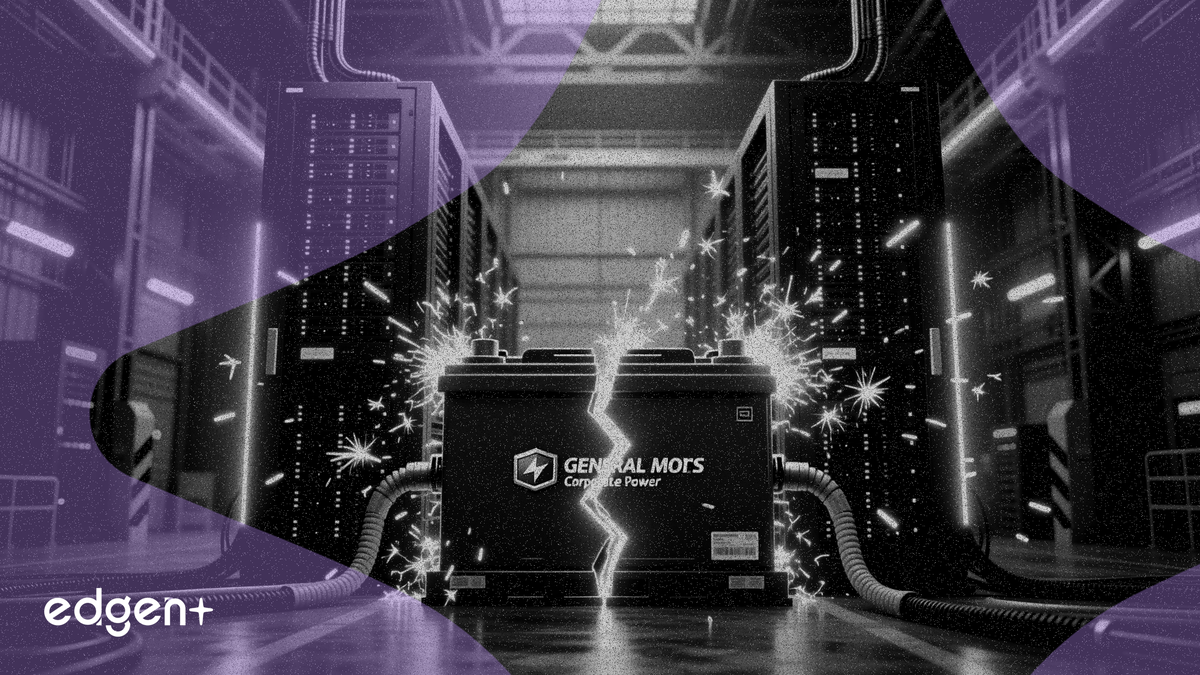
General Motors is retooling its battery business to capture surging electricity demand from AI data centers, announcing sodium-ion storage systems and vehicle-to-grid capabilities on the same day.
General Motors Co. on Tuesday unveiled sodium-ion batteries for grid-scale energy storage and activated vehicle-to-grid capabilities for its EVs, targeting the surging electricity demand from AI data centers that is straining power grids across the US.
"We see a future where electric vehicles, batteries that power them, and the country's power grids work together," Sterling Anderson, GM's chief product officer, said at an event in San Francisco.
The automaker is developing sodium-ion chemistry with Peak Energy, a startup backed by GM Ventures, for stationary storage where energy density matters less than cost and durability. Sodium-ion batteries use one of Earth's most abundant elements, offering lower material costs and better cold-weather performance than lithium-ion, though they are heavier and require more frequent charging — drawbacks that matter little for grid storage. GM is also activating vehicle-to-grid capability for its 250,000 bidirectional-capable Chevrolet, Cadillac and GMC EVs on US roads through a firmware update, with a pilot involving 52,000 vehicles in partnership with PG&E in Northern California targeting 2030 operations.
The dual-pronged strategy positions GM to capture revenue from the rapidly growing data center energy infrastructure market, diversifying beyond EV sales that have fallen short of expectations. The company wrote down $6 billion in EV investments last year as it slowed production targets, making the energy storage pivot a critical hedge. GM shares could benefit from the new revenue stream, though the company faces competition from Tesla, which already dominates the $150 billion home energy market, and from battery recyclers like Redwood Materials that are also repurposing EV packs for grid storage.
Sodium-Ion: A Chemistry Built for the Grid
GM's bet on sodium-ion represents a strategic divergence from its EV battery roadmap. While the company pursues lithium manganese-rich chemistry for its vehicles and uses NMC technology in current models, sodium-ion is purpose-built for stationary storage where "their priority is not maximizing range or minimizing weight," Kurt Kelty, GM's vice president of battery and sustainability, said. "It is delivering reliable, affordable power over long periods of time in real-world conditions."
China's CATL, the world's largest battery maker, has projected that sodium-ion could replace up to half of the lithium iron phosphate market, which currently dominates grid storage. GM expects to begin producing its own sodium-ion cells by 2028, with prototyping underway at its Wallace Battery Cell Innovation Center in Warren, Michigan.
Vehicle-to-Grid: Turning EVs Into Power Plants
GM's V2G activation turns its existing EV fleet into a distributed energy resource. The company estimates the combined battery capacity of its 250,000 bidirectional-capable vehicles could power 120,000 homes for a week. In Michigan, GM is working with DTE Energy to test the system using 30 employee homes as real-world cases.
The technology faces regulatory hurdles. Wade Sheffer, GM Energy's vice president, urged regulators to formalize V2G infrastructure in an open letter, citing International Energy Agency reports that identify V2G as the technology with the largest hourly flexibility to limit future grid investment costs.
Second-Life Batteries and the Circular Economy
GM is also extending its battery strategy through partnerships. The company is working with Redwood Materials to build energy storage from US-manufactured batteries and second-life EV packs, with a plan to power a GM manufacturing facility in Michigan starting next year. The approach mirrors Waymo's recent deal with B2U Storage Solutions to repurpose retired robotaxi batteries into grid-scale storage, reflecting a broader industry shift toward battery circularity.
For investors, GM's energy pivot opens a new growth vector at a time when its core EV business faces headwinds. The data center energy storage market is expanding rapidly as hyperscalers race to secure power for AI workloads. If GM can scale sodium-ion production and enroll enough V2G participants, the energy division could offset some of the $6 billion in EV-related writedowns. However, execution risk remains high: Tesla has a multiyear head start in stationary storage with its Megapack product, and regulatory approval for V2G programs is far from guaranteed.
This article is for informational purposes only and does not constitute investment advice.
