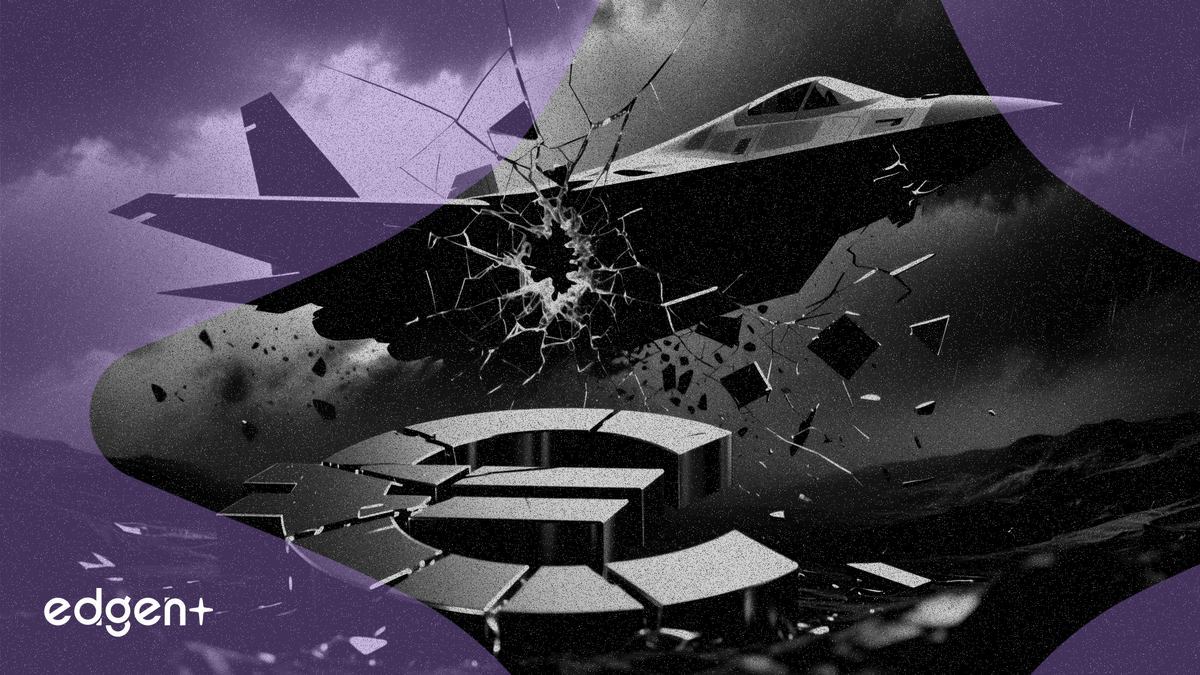
The collapse of Europe's most ambitious defense program leaves the continent without a homegrown next-generation fighter as the US reduces its military footprint and Russia presses its advantage.
Germany pulled out of the €100 billion ($116 billion) Future Combat Air System stealth-fighter project with France and Spain on Monday, bowing to an irresolvable leadership dispute between Airbus and Dassault Aviation that had paralyzed development for months.
The decision, confirmed by a senior German government official, came after Chancellor Friedrich Merz concluded that the two defense contractors could not be forced to cooperate. Merz informed French President Emmanuel Macron of the withdrawal on the sidelines of the EU-Western Balkans summit in Montenegro last week, following a final conversation with Dassault Chief Executive Eric Trappier.
"It's hardly ideal signaling either to Washington or to Moscow," said Douglas Barrie, senior fellow for military aerospace at the International Institute for Strategic Studies. "Europe's inability to execute a project of this scale raises questions about its capacity to rebuild military capability after decades of underinvestment."
The FCAS program, launched by Macron and former Chancellor Angela Merkel in 2017, was designed to produce a sixth-generation stealth fighter supported by drone swarms and linked through an artificial-intelligence-powered "combat cloud." The aircraft was meant to close the gap with US, Chinese and Russian stealth fighters and reduce European dependence on the Lockheed Martin F-35, which has become an emblem of the region's vulnerability to shifts in US defense policy.
That dependence has grown more acute as the US redirects European orders of Patriot interceptors, High Mobility Artillery Rocket Systems and other weapons to itself and Ukraine, while European nations face extended waits for F-35 deliveries. President Donald Trump's order to withdraw 5,000 US troops from Germany has further accelerated the urgency for Europe to develop independent defense capabilities.
The project's collapse stems from a fundamental disagreement over industrial leadership. Dassault Chief Executive Eric Trappier insisted his company should lead development because of its track record in building combat aircraft, while Airbus, whose defense business is based mainly in Germany, pushed back. The two sides also clashed over access to intellectual property and differing requirements for the aircraft — Germany questioned whether a manned sixth-generation fighter still made strategic sense, while France required a nuclear-capable jet that could operate from aircraft carriers.
The breakdown echoes France's withdrawal from the Eurofighter program in the 1980s, a pattern of Franco-German industrial rivalry that has repeatedly undermined European defense integration. The last time a joint European fighter project collapsed, the UK-led Eurofighter went on to become one of the continent's most successful military aircraft programs, with 680 aircraft delivered across seven air forces.
Berlin now has no fighter-aircraft program to work on. The rival Global Combat Air Program, led by the UK with Italy and Japan, is too far advanced to redistribute work share, according to a person familiar with the matter. Companies involved in GCAP — BAE Systems, Leonardo and Mitsubishi Heavy Industries — are not currently in talks with Airbus about joining, the person said.
The German withdrawal caught French officials by surprise, according to people familiar with the matter. Paris had taken the view that governments needed to apply more pressure on the defense firms to cooperate. Macron's office said France would continue to encourage cooperation on ambitious European projects that serve the country's security interests.
Berlin and Paris will meet in July to develop a road map for future defense cooperation based on a limited number of more realistic projects, the German official said. The two countries are also implementing an agreement to extend France's nuclear deterrent to Germany and other European nations, a process that Berlin hopes will be eased by removing the FCAS irritant.
For the defense industry, the collapse reshapes the competitive landscape. Airbus faces the loss of a major program that would have secured its position in combat aviation for decades. Dassault could proceed with a national fighter program but would lose the economies of scale that a trilateral project provided. US defense contractors, including Lockheed Martin and Boeing, stand to benefit in the near term as European nations seek alternatives to fill the capability gap.
The broader lesson for European defense is stark: the continent spends more on military procurement than any aligned group of countries outside the US, yet struggles to translate that spending into coherent multinational programs. The FCAS failure joins a list of stalled cross-border projects that includes the Franco-German Main Ground Combat System tank program, raising questions about whether Europe can achieve the defense sovereignty it has declared as a strategic objective.
This article is for informational purposes only and does not constitute investment advice.