

The European Union's ban on public funding for Chinese-made solar inverters threatens to slow the bloc's renewable energy rollout.
The European Union's ban on public funding for Chinese-made solar inverters threatens to slow the bloc's renewable energy rollout.
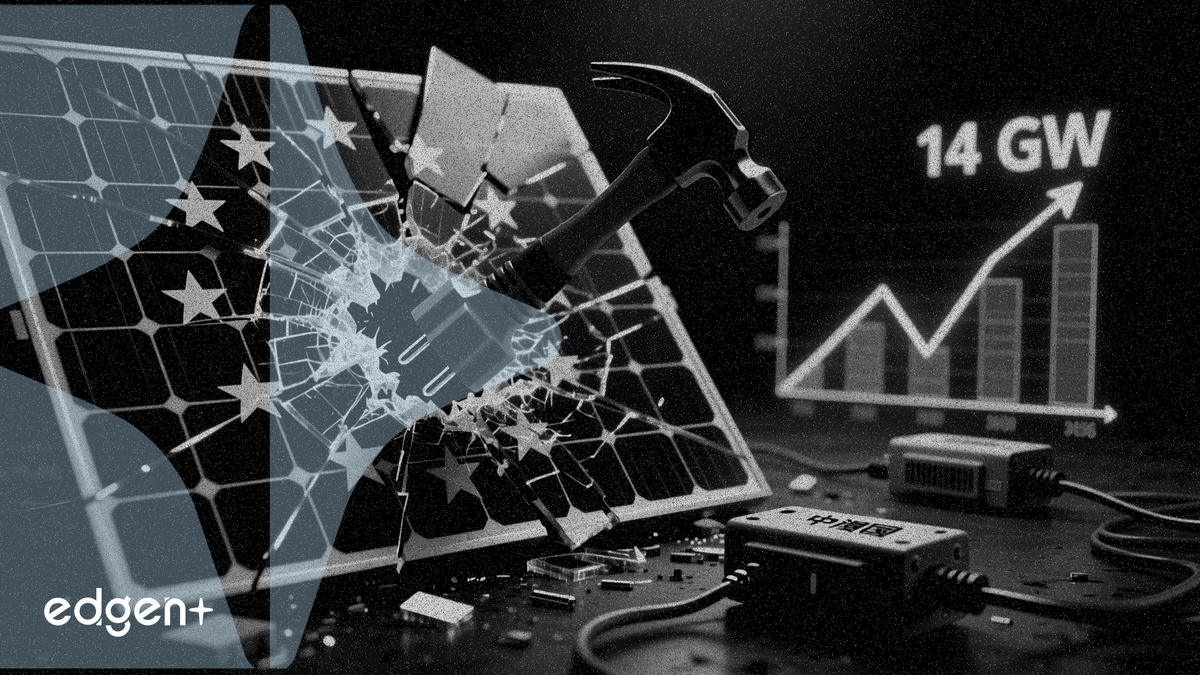
The European Union's prohibition on public funding for Chinese-made solar inverters could stall more than 14 gigawatts of new solar capacity — over a fifth of annual installations — as the bloc confronts a growing tension between energy security fears and its climate targets.
"This could mean a remote shutdown of member states' networks, leading to countrywide blackouts," a European Commission spokesperson said when the restriction was imposed last month. The ban targets internet-connected inverters from "high-risk" countries including China, which officials warn could provide a back door for foreign actors to disrupt electricity systems through remote software updates.
Chinese manufacturers led by Huawei and Sungrow supplied about 70 percent of Europe's inverters in recent years, according to Reuters calculations, leaving the bloc heavily reliant on foreign equipment for a fast-growing share of its power supply. The curbs now force developers to seek costlier alternatives, with EU-made inverters priced 20 percent to 40 percent higher than Chinese parts, adding roughly 2 percent to total system costs — enough to squeeze already thin margins in subsidy-dependent markets.
The policy exposes a fundamental trade-off: protecting grid security while racing to meet renewable energy targets that require rapid, cost-effective deployment. In Central and Eastern Europe, where subsidy schemes underpin many installations, the impact could be severe. Wood Mackenzie data shows 9 GW of large utility-scale projects across all markets hold EU financing commitments. In Latvia and Estonia, 70 percent of household solar installations receive some form of EU support, while the European Bank for Reconstruction and Development loaned Hungary €70 million ($81 million) this year for a 700-MW solar and battery storage project.
European Producers Race to Fill the Gap
European manufacturers say they can ramp up output to meet the extra demand. SMA Solar, the German inverter maker, said it is "well-positioned" for a potential rise in order intake, with one of the sector's largest production facilities in Niestetal, Germany, and a new multi-gigawatt factory at the same site set to open in September. Austrian rival Fronius said Western manufacturers could fulfill European demand within a year, though it would need to hire more staff — a step CEO Elisabeth Engelbrechtsmüller-Strauss argues requires stronger EU restrictions to justify the investment.
"It is not sufficient to simply stop subsidising these products. Such components should not be allowed to be connected to the public electricity grid," Engelbrechtsmüller-Strauss told Reuters.
Others are less optimistic. Without Chinese technology, renewable targets could slip in the short to medium term, said Evangelos Gazis, an analyst at Aurora Energy Research. Jan Krcmar, executive director of the Czech Solar Association, whose members include Huawei, said he expects "a drop down of at least two-thirds of installations in the next one, two, three years."
Stricter Measures on the Horizon
The curbs currently apply only to new and in-progress projects, leaving more than 200 GW of Chinese-made inverter capacity already embedded in Europe's grid — an exposure critics say still gives Chinese firms remote access to control systems. Some member states are already moving beyond the EU's initial stance. Lithuania has blocked remote access from Chinese suppliers to inverter control systems, with Energy Minister Zygimantas Vaiciunas saying new inverters "should be EU produced, or US produced." Poland's state secretary for energy, Wojciech Wrochna, said the country is assessing national options, adding that "if we see that there is a threat, the answer to that question should be a total ban."
EU officials say tougher restrictions may follow. A proposed legal framework under negotiation could pave the way for a bloc-wide ban on inverters from high-risk suppliers, depending on an ongoing security assessment. "This is determined first and foremost by Chinese behaviour," a senior EU official said.
For investors, the policy shift creates clear winners and losers. European inverter makers SMA Solar and Fronius stand to gain market share as demand shifts to local suppliers, while Chinese producers Huawei and Sungrow face a shrinking addressable market in one of the world's largest solar regions. Solar project developers, particularly those reliant on EU subsidies in Central and Eastern Europe, face higher costs and potential delays that could compress returns. The broader risk is that Europe's renewable energy targets — which require roughly 70 GW of new solar annually — become harder to achieve as the cost of key components rises and installation timelines stretch.
This article is for informational purposes only and does not constitute investment advice.
