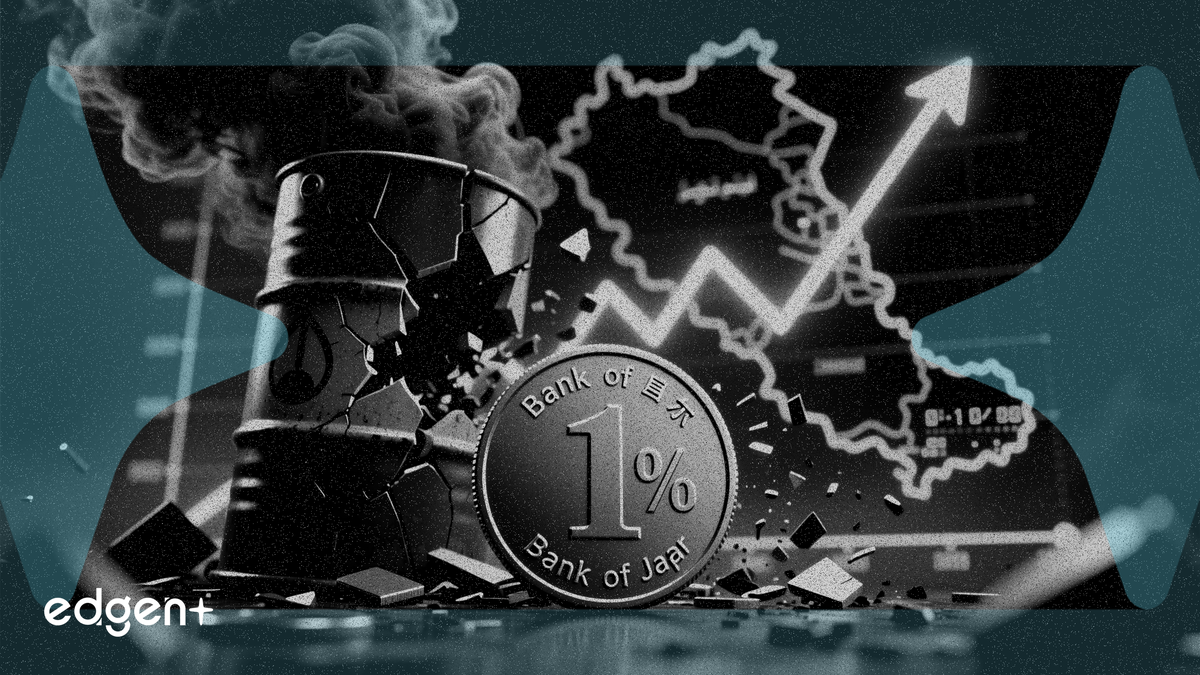
BOJ Deputy Governor Shinichi Uchida took the unprecedented role of leading a rate decision press conference Tuesday as Governor Kazuo Ueda remained hospitalized, raising Japan's benchmark rate to a 31-year high of 1% while navigating the crosscurrents of a US-Iran peace deal that could reshape the inflation outlook.
The Bank of Japan raised its short-term policy rate to 1% on Tuesday, the highest since 1995, as Deputy Governor Shinichi Uchida presided over the decision in place of a hospitalized Kazuo Ueda and signaled further tightening ahead.
"Uchida is good at communicating with constructive ambiguity," said Seisaku Kameda, a former top BOJ economist who now runs his own research firm. "With so much uncertainty over the outlook, he will signal the BOJ's readiness to respond nimbly."
The 25-basis-point move, the first since December, was backed by eight board members after Ueda's absence due to treatment for an infected liver cyst. Three of nine members had already proposed a hike to 1% at the April meeting. The yen held above 160 per dollar even after the decision, with speculative net short positions climbing to the highest since July 2024, Commodity Futures Trading Commission data showed Friday. Japan's wholesale inflation accelerated to 6.3% in May, a three-year high, while government subsidies have kept core consumer prices below the BOJ's 2% target.
The rate increase comes as a preliminary US-Iran peace deal, with signing set for Friday, threatens to ease the energy-driven inflation that has justified the BOJ's tightening cycle. A prolonged war could have kept inflation near 3% for two years, Kameda said, potentially justifying faster hikes. The BOJ now faces the challenge of sustaining its normalization path as oil prices decline, with economists projecting a further increase to 1.25% in the fourth quarter.
Uchida, who was himself discharged from hospital last month, told reporters the economy was recovering moderately and that downside risks had decreased. He said there was a risk of prices exceeding 2% and confirmed the BOJ would continue raising rates based on economic and price conditions. On bond market volatility, he said the central bank would flexibly increase purchases if yields surged, while allowing long-term rates to be determined by markets.
The absence of Ueda, who has been the public face of the BOJ's normalization drive since taking office in 2023, added an element of uncertainty. Market participants accustomed to parsing Ueda's press conference language for policy signals were left to interpret Uchida's first extended public remarks in weeks. "Market players tried to read the difference in Ueda's comments at each press conference to gauge his stance, but this time, they can't do that," said Kumiko Ishihara, a senior analyst at Sony Financial Group.
The peace deal between Washington and Tehran alters the calculus for the BOJ's next moves. A drop in oil prices reduces the urgency of rate increases aimed at containing imported inflation, though the weak yen continues to push up import costs broadly. The Ministry of Finance spent a record 11.7 trillion yen ($73.12 billion) in April to bolster the currency after it breached 160 per dollar.
"The yen is still rather weak on the background of the BOJ still being behind the curve," said Naka Matsuzawa, chief strategist at Nomura Securities. "I don't really think the BOJ can satisfy the market expectations on hawkishness."
Markets are pricing one more rate increase from the BOJ later this year, though expectations have been complicated by shifting global dynamics. The European Central Bank has also signaled tighter policy after Iran-war inflation, while the Federal Reserve's next move is increasingly seen as a hike rather than a cut, according to a Reuters poll of economists.
"If expectations for further rate hikes by the Fed continue against the backdrop of US inflation, there is a meaningful possibility that the dollar will remain strong," said Hirofumi Suzuki, chief FX strategist at SMBC.
The BOJ's next policy meeting is scheduled for July, with economists split on whether the central bank will deliver another hike or pause to assess the impact of the Iran peace deal on Japan's energy-dependent economy.
This article is for informational purposes only and does not constitute investment advice.