


Key Takeaways:
- The Fed's June SEP slashed GDP forecasts while projecting PCE inflation at 3.6%
- Nearly half of FOMC members penciled in at least one rate hike for 2026
- Defensive dividend stocks offer income stability during hawkish policy shifts
Key Takeaways:
Dividend-paying stocks are drawing renewed interest from investors seeking income stability as the Federal Reserve's hawkish June projections raised the prospect of a rate hike this year.
"The Fed's updated outlook removes any near-term hope for rate cuts and reinforces the case for income-generating equities," said Sarah Lin, equity strategist at Edgen. "When the policy path is uncertain, dividends provide a return component that doesn't depend on multiple expansion."
The S&P 500 slumped 1.2% to 7,420.10 on Wednesday after the Fed's Summary of Economic Projections showed nearly half of the Federal Open Market Committee's 19 members forecast at least one rate increase in 2026. The Dow Jones Industrial Average fell 1% to 51,492.55, reversing a 0.5% gain earlier in the session, while the Nasdaq Composite dropped 1.3% to 26,021.66. The Russell 2000 index of smaller companies declined 0.7% to 2,917.98.
The central bank held its benchmark overnight borrowing rate steady at 3.5% to 3.75%, as widely expected. But the accompanying projections painted a starkly more restrictive picture: the Fed slashed its GDP growth expectations while projecting sticky personal consumption expenditures inflation at 3.6%, double its 2% target. The 10-year Treasury yield jumped to 4.5% from 4.45% a day earlier, its highest level in a week.
New Chair Kevin Warsh, holding his first post-meeting press conference, announced an overhaul of the central bank's operations, including five task forces addressing communications, the balance sheet, data sources, productivity and jobs, and inflation frameworks. He abstained from publishing policymakers' dot plot projections, saying the revamped policy statement was "a bit shorter, a bit simpler."
Why Dividends Work in a Hawkish Environment
When the Fed signals higher-for-longer rates, growth stocks — particularly in technology — face valuation compression as future cash flows are discounted at higher rates. Dividend stocks, by contrast, offer immediate cash returns that become relatively more attractive when bond yields rise but remain below inflation.
Utilities, consumer staples, and healthcare sectors typically exhibit lower beta and higher dividend yields, making them natural destinations for defensive rotation. The S&P 500's dividend yield stood at roughly 1.3% as of Wednesday's close, compared with the 10-year Treasury's 4.5%, a gap that historically narrows when rate expectations stabilize.
Three Dividend Stocks for Defensive Positioning
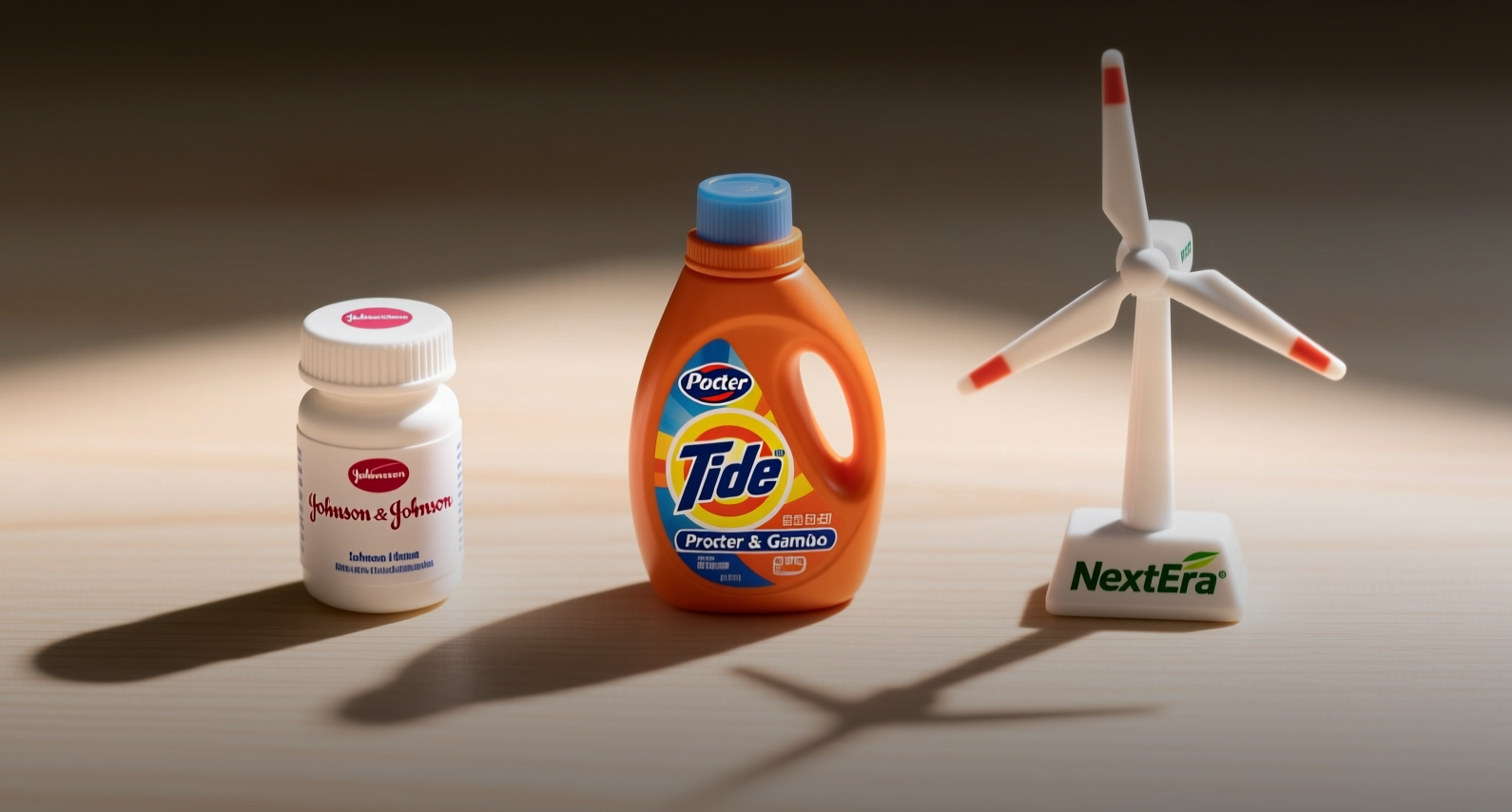
While the broader market digests the Fed's hawkish pivot, three dividend-paying names stand out for their combination of yield, payout sustainability, and defensive business models.
Johnson & Johnson (JNJ) offers a dividend yield of approximately 3.2% with 62 consecutive years of dividend increases. The healthcare giant's diversified revenue stream — spanning pharmaceuticals, medical devices, and consumer health — provides earnings stability regardless of the rate cycle. Its payout ratio of roughly 45% leaves ample room for continued growth.
Procter & Gamble (PG), the consumer staples bellwether, yields about 2.5% with 68 years of dividend growth. The company's portfolio of household essentials generates consistent cash flow through economic cycles, and its gross margins have held above 48% despite input cost pressures. PG's low earnings volatility makes it a staple of defensive portfolios during macro uncertainty.
NextEra Energy (NEE), the largest utility by market capitalization, yields approximately 2.8%. The company's regulated utility operations provide rate-base growth of 8% to 10% annually, while its renewable energy arm benefits from long-term power purchase agreements. NextEra's dividend has grown at a compound annual rate of roughly 10% over the past decade, supported by a payout ratio near 60%.
What Comes Next
The Fed's next meeting is scheduled for July 28-29, with markets pricing in a 35% probability of a quarter-point hike, according to CME FedWatch data. The July consumer price index report, due July 15, will be the critical data point determining whether the hawkish projections become policy reality.
For dividend investors, the calculus is straightforward: if the Fed delivers a hike, defensive dividend stocks should outperform growth names as discount rates rise. If the central bank holds steady, the income component still provides a floor against further multiple compression. Either scenario favors companies with pricing power, low debt, and proven dividend track records.
This article is for informational purposes only and does not constitute investment advice.
